


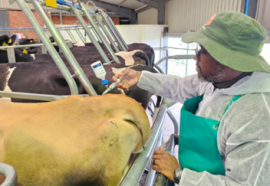
Minister of Agriculture John Steenhuisen has launched a nationwide mass vaccination campaign against Foot and Mouth Disease (FMD), following the rapid arrival and distribution of vaccine consignments aimed at curbing outbreaks across the country.
Steenhuisen visited Colbourne Dairy Farm near Mooi River in KwaZulu-Natal on Friday, as part of the official rollout of the Department of Agriculture’s intensified response to the highly contagious livestock disease.
The first major consignment of one million FMD vaccine doses, sourced from Biogénesis Bagó in Argentina, arrived in South Africa on Saturday, 21 February 2026. Within days, Onderstepoort Biological Products (OBP) had distributed the vaccines to all nine provinces, completing dispatch by Wednesday, 25 February 2026.
KwaZulu-Natal received 200 000 doses, followed by the Free State with 200 000 and the Eastern Cape with 150 000. Mpumalanga, North West and Limpopo each received 100 000 doses, Gauteng 70 000, the Northern Cape 50 000 and the Western Cape 30 000.
A further 1.5 million doses from Turkey-based manufacturer Dollvet were scheduled to arrive in the country on Saturday, 28 February 2026, with additional consignments from Argentina expected shortly thereafter.
Locally, the Agricultural Research Council (ARC) has committed to producing 20 000 vaccine doses per week, with plans to scale up production to 200 000 doses weekly by 2027 to strengthen long-term biosecurity capacity.
Steenhuisen commended the KwaZulu-Natal Department of Agriculture and Rural Development for initiating vaccinations within 24 hours of receiving supplies. The province has been identified as the primary FMD risk epicentre, with more than 1.6 million cattle in high-priority zones and a total herd of approximately 2.4 million.
“We are committed to protecting the livelihoods of our farmers, from our communal lands to our commercial operations. This department has ensured that 45 teams will be deployed daily to 45 locations to vaccinate up to 90 000 animals per day to cover the 2.4 million cattle herd in the province,” Steenhuisen said.
Shift to protect the dairy sector
The Minister also announced measures to ease pressure on the dairy industry, which has faced economic strain amid movement restrictions.
With effect from 24 February 2026, there are no restrictions on milk from vaccinated, uninfected farms or from farms that have not been infected or suspected of being infected with FMD. The change is captured in the amendment of the 2024 FMD Contingency Plan, which is expected to be gazetted soon.
For the movement of milk originating from quarantined farms, only a single pasteurisation process will be required for local consumption. However, milk from properties under FMD restriction may not be processed for the export market, unless expressly approved by the importing country.
“We are moving away from treating high-risk farms as guilty until proven innocent. Only farms with confirmed or clinical signs of infection will be quarantined.
“We will not stop until FMD is eradicated, and South Africa receives its ‘FMD free with vaccination’ status. This is our promise to our farmers: We are doing everything in our power to keep your milk moving and your herds safe,” Steenhuisen said.
The Minister also welcomed Cabinet’s approval of the national mass vaccination programme and the National Treasury’s reallocation of approximately R400 million underspent agriculture funds toward the war on FMD.
READ | Cabinet backs local FMD vaccine production
Easing restrictions
To ease restrictions on affected farms as soon as possible, the Veterinary Working Group has also agreed to immediate amendments to guidelines aimed at easing restrictions on affected farms, pending formal regulatory updates.
On infected or suspected premises, all cloven-hoofed animals must be individually identified and recorded in a traceability database. On farms not infected or suspected of infection, vaccinated animals must likewise be individually identified and recorded to ensure lifelong traceability. Authorities confirmed that no “F” branding will be required for suspect, infected, or vaccinated animals.
Controlled slaughter protocols have also been adjusted. For slaughter within three months of the outbreak’s “day zero”, existing risk mitigation measures at designated abattoirs remain in place. From three months after day zero, controlled slaughter from quarantined premises may occur at any registered non-export abattoir.
Meat processed after three months must undergo maturation, but will not require additional risk mitigation measures or carcass part removal. As with milk, animals from properties under FMD restriction may not be slaughtered for export markets unless agreed to by the importing country.
National effort
Steenhuisen expressed gratitude to farmers, including farm workers and industry bodies, for their cooperation amid strict movement controls and vaccination protocols.
“In the face of this unprecedented outbreak, the practical cooperation on movement controls and vaccination, and the willingness to work within difficult restrictions have reminded us that this is a national effort—one that the government cannot wage alone,” he said. – SAnews.gov.za


