


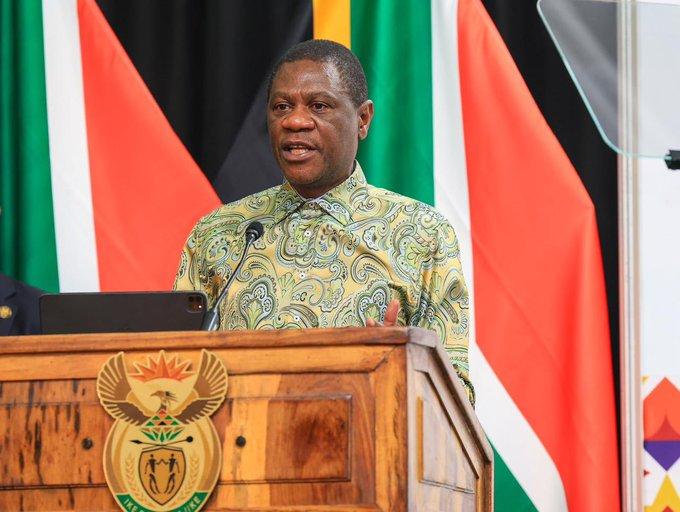
Deputy President Paul Mashatile has called on trade unions to place themselves at the forefront of the transition to artificial intelligence by championing policies that put people at the centre of technological advancement.
“The rise of artificial intelligence presents organised labour with a historic challenge and opportunity. Those who anticipate change and prepare workers with the skills, protections and voice needed in the digital economy will help shape the future,” Mashatile said on Wednesday.
Speaking at the Federation of Unions of South Africa’s (FEDUSA) 8th National Congress in Johannesburg, he stressed that failure to do so could allow technological change to deepen inequality and exclusion.
“Those who fail to do so risk allowing technological change to deepen inequality and exclusion. Subsequently, trade unions must prepare to bargain over workplace data, technological restructuring and access to upskilling and reskilling. They must be able to represent workers in informal, digital and other insecure forms of employment,” Mashatile said.
He challenged FEDUSA to consider whether the institutions established to advance workers’ interests are fulfilling their purpose, noting that, despite the country’s laws, the labour market continues to reflect deep inequalities.
FEDUSA is one of South Africa’s recognised national trade union federations and represents workers across a wide range of industries in the public and private sectors.
“Despite our progressive labour laws, the labour market still reflects inequalities of race, gender and disability, particularly at senior management levels. Legislation alone will not achieve transformation.
“Employers must address unequal recruitment, pay disparities and inadequate skills development. Trade unions must actively monitor whether employment equity plans deliver results,” he said.
The Deputy President said transformation must be evident in the structure of the economy, rather than merely reflected in formal compliance.
Cost of living
Mashatile expressed concern about the rising cost of living, noting that electricity has become increasingly expensive.
He said government is therefore reviewing the electricity pricing policy to balance the needs of vulnerable households with the sustainability of supply and industrial competitiveness.
“We are also tackling poor maintenance, theft and weak revenue management in municipal distribution so that responsible consumers do not bear the burden of avoidable losses,” he said.
While government has made important progress in stabilising electricity generation, high electricity costs continue to constrain South Africa’s economic growth.
“Electricity has become increasingly expensive, weakening energy-intensive industries such as steel, ferroalloys and chemicals, and straining household incomes. We cannot build our industry without addressing electricity affordability,” the Deputy President said.
Job creation
Mashatile emphasised that South Africa’s most urgent national task is to achieve stronger economic growth and create jobs on a scale that substantially reduces poverty and inequality.
He said this was necessary in response to an economy that contracted by 0.2% in the second quarter of 2026, with the mining, manufacturing and trade sectors under considerable pressure.
About 8.5 million South Africans are unemployed, while the official unemployment rate has risen to 33.6%.
“These figures represent people unable to provide for their families, graduates unable to enter the labour market, and communities where opportunity is limited. When a factory closes, suppliers lose business, local enterprises lose customers and entire communities decline,” the Deputy President said.
He said the congress theme: “Reclaiming and Organising the Future: Workers’ Dignity, Power, and Justice through Conscious Unionism in an Age of Crisis,” should inspire both government and business.
“For government, it requires competent administration and accountability. For business, it requires responsible investment and fair employment practices. For organised labour, conscious unionism requires democratic leadership, accountability to members and ethical conduct.
“Government must show through its actions that it takes organised labour’s concerns seriously. We must create opportunities for young people, protect existing jobs, make electricity more affordable, expand industrial production and ensure that the transition to a sustainable economy is fair.
“Our democratic settlement was built on the conviction that negotiation could resolve differences. We must renew that conviction through our actions,” Mashatile said. -SAnews.gov.za


