


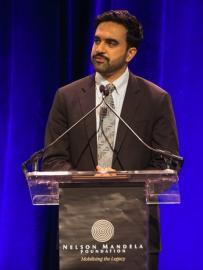
New York City Mayor Zohran Mamdani has reflected on former President Nelson Mandela’s enduring legacy, the importance of solidarity in confronting injustice, and the responsibility of leaders and citizens to build societies rooted in dignity, freedom and equality.
Mamdani recalled the injustices former President Mandela endured, including his imprisonment, the abuse that left him with permanently damaged eyesight, and his continued presence on United States terror watch lists until 2008, when he was 90 years old.
Despite the hardship Madiba endured for resisting oppression, Mamdani praised his capacity to forgive and to extend solidarity to all, helping to shape a future for South Africa that differed from its past.
“It is only through that solidarity that we can do the same. Solidarity, as Madiba showed us for 95 years, is not just a value; it is a strategy. Madiba showed us the power of solidarity, universal and unyielding. In his demand for solidarity from himself and from each of us, Madiba becomes more than a man, more than a Messiah. He becomes a mirror,” Mamdani said.
The Mayor was speaking on Wednesday ahead of International Nelson Mandela Day at the inaugural Nelson Mandela Global Leadership Forum, hosted by the Nelson Mandela Foundation at The Town Hall in New York City. The forum creates a new global platform for conversations on the leadership challenges shaping the world today.
As the world marks Nelson Mandela Day on 18 July, Mamdani said that while people remember Madiba the man, they should also ask themselves a harder question: who is being treated today the way Madiba was treated before history declared him a Messiah?
The Mayor called on the international community to confront injustice as Mandela did, without waiting for it to become popular to do so.
“Eventually, almost everyone claims they opposed apartheid. Eventually, almost everyone claims they stood with Madiba. Eventually, almost everyone will claim they oppose so much of the injustice that they justify today. But justice is not measured by where we stand after history has issued its verdict. It is measured by where we stand when the verdict is still being rendered,” he said.
Mamdani referred to parents losing their children in Palestine; Dr Hussam Abu Safiya waiting more than 18 months for freedom in Israeli detention; Umar Khalid, who has been in captivity for six years in Delhi, and Joan Sebastian Guerrero, who was shot in the head by US Immigration and Customs Enforcement in Biddeford.
“Why must we wait to practice solidarity until it no longer costs us anything? The responsibility of answering those questions honestly and fully rests upon each of us. It is a responsibility of drawing solidarity further into our lives, our politics, the way we walk through the world,” he said.
The Mayor acknowledged that this was no easy task, as the world is often designed to tear humanity apart.
“When Madiba endured decades of racial domination and dehumanization, was that conducive to solidarity? The truth is that solidarity is perhaps best nurtured by the conditions that seek to destroy it. Solidarity is not perfection. Solidarity is not purity. Solidarity is people choosing one another sometimes even over themselves,” Mamdani affirmed.
He said there are people with hardly anything to their name who still open their hands to share what little they have with those who have even less.
“Solidarity, my friends, so often feels impossible. Like something only a mythical figure could make real. And yet, as Madiba reminds us through the life he lived, through the leadership he showed. And through the words he spoke, it always seems impossible until it's done. Let us do it together,” the Mayor said. -SAnews.gov.za


