


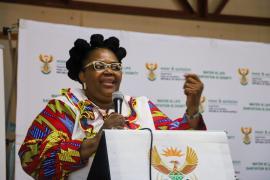
Water and Sanitation Minister Pemmy Majodina has called for accountability and collective action, urging all stakeholders to reject complacency and prioritise the protection of water resources.
The call comes as the 2025 Green Drop Report released on Tuesday, revealed that South Africa’s wastewater management systems are deteriorating at an alarming rate, with nearly half of them classified in a critical state.
Releasing the report, Majodina framed the findings not only as a warning, but as an opportunity to drive urgent reform and restore failing systems.
“This report must be a turning point. Decline is not destiny, failure is not permanent, and broken systems can be rebuilt.”
The report assessed 848 wastewater treatment systems audited for the 2023/24 municipal financial year. The assessment included on-site audits of at least two wastewater treatment systems per metropolitan municipality and one wastewater treatment system per district or local municipality.
The 2025 report is compared with the prior 2022 Green Drop Report, which assessed the 2020/21 municipal financial year. In 2022, 850 systems were audited, slightly more than the 848 in 2025 due to the decommissioning or merging of some systems.
The report found that the proportion of systems in a critical condition has increased to 47% (396 systems), up from 39% (334 systems) in 2022.
Systems achieving excellent or good performance declined significantly from 14% (118 systems) to 8% (66 systems).
Only 14 systems achieved Green Drop certification in 2025, down from 22 in the previous report, highlighting what the Minister called a “clear deterioration in municipal wastewater performance.”
“This is not merely another report, a routine publication, or a compliance exercise. It shows us how effectively we are protecting our water resources, safeguarding public health, and fulfilling our constitutional responsibility to uphold the dignity of our people,” the Minister said.
Mixed signals in water quality and efficiency
The Green Drop findings were released alongside Progress Assessment Reports for Blue Drop (drinking water quality) and No Drop (water use efficiency) for the 2023/24 municipal financial year.
While drinking water systems showed modest improvement, with low-risk systems increasing from 60.2% to 61.9%, and critical-risk systems decreasing from 9.9% to 7.9%, the Minister warned against complacency.
“Critical and high-risk systems still require urgent corrective action,” Majodina said, urging intensified regulatory oversight.
Nationally, the percentage of non-revenue water has remained roughly constant at 47.3%, compared with 47.4% in the 2023 No Drop report, a level described as “stabilised but unacceptably high”.
The underlying causes of poor performance in terms of Drop reports include non-adherence to standard operating procedures for drinking water treatment and wastewater treatment, infrastructure in poor condition due to lack of maintenance, and municipalities failing to hire qualified staff or prioritise budgets for maintenance and operations.
Weak billing and revenue collection, poor municipal leadership and management, and the absence of a legal requirement for municipalities to use water and sanitation revenue for maintenance. further exacerbate the problem.
Performance across provinces remains uneven with Western Cape and Gauteng continue to lead with the strongest risk profiles, while Mpumalanga and North West recorded notable improvement.
However, the Northern Cape was flagged as the worst-performing province, with the highest concentration of critical-risk systems severe weaknesses across multiple indicators. The Free State also remains a province of material concern.
Despite these challenges, metropolitan drinking water systems generally meet national standards, and where municipalities comply with SANS 241 requirements, tap water is considered safe for consumption.
Majodina encouraged residents to verify with their municipalities that testing and compliance with SANS 241 are being conducted.
Root causes for the decline
The report highlighted systemic issues behind the decline, including poor maintenance of ageing infrastructure, failure to adhere to operational standards, and a lack of skilled personnel. Weak municipal leadership, inadequate budgeting for maintenance, and poor revenue collection further compound the crisis.
The Minister noted that these findings are corroborated by research from the Department of Cooperative Governance, National Treasury, the Auditor General, and other institutions, all of which point to municipalities lack the capability to discharge their governance and service delivery mandates effectively.
Criminal activities, including vandalism, corruption, and attacks on water and energy infrastructure, are also exacerbating the situation.
Water crisis declared a national priority
The report comes amid a broader national warning, as President Cyril Ramaphosa has declared South Africa’s water situation a crisis requiring urgent intervention.
In response, government has established the National Water Crisis Committee (WaterCom), chaired by the President, to coordinate action across all spheres of government.
“The declaration is not symbolic; it is a call to action,” the Minister said, pointing to challenges such as deteriorating infrastructure, declining water quality, and the growing impact of climate change.
In response, government has adopted a multi-pronged approach.
Despite the bleak findings, the Minister stressed that the report also offers a pathway forward, highlighting examples of municipalities and professionals achieving excellence under difficult conditions.
“Let this be the moment when we refuse to normalise sewage pollution and recommit ourselves to safeguarding every river, wetland, and community that depends on them,” the Minister said. – SAnews.gov.za


