


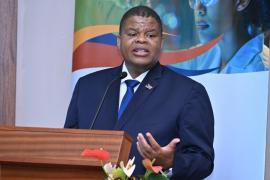
Water and Sanitation Deputy Minister David Mahlobo has underscored the critical role of academic institutions in shaping solutions to South Africa’s water challenges.
Delivering the keynote address at a recent Water Imbizo hosted by the University of South Africa (UNISA), Mahlobo described the country’s water challenges as structural and systemic in nature, saying that coordinated and science-based interventions are essential to addressing the crisis.
While South Africa remains water-scarce, Mahlobo noted that current shortages are largely driven by ageing and deteriorating infrastructure, weak governance, declining municipal capacity, pollution, and persistently high levels of non-revenue water, which stands at approximately 47%.
“This is not just a resource challenge. It is a governance, infrastructure and capability challenge that demands coordinated action across the entire system,” the Deputy Minister said.
Mahlobo emphasised that water security is both a constitutional obligation and a developmental and economic imperative, underpinning public health, food security, industrial growth and human dignity.
He warned that without decisive intervention, increasing demand, climate variability and inefficiencies will place growing strain on already vulnerable water systems.
The imbizo was positioned as a key national platform, bringing together government, academia and sector stakeholders to advance practical, evidence-based responses to the country’s water crisis.
Highlighting the importance of academia, Mahlobo said the country’s response must be firmly grounded in scientific evidence, innovation and technical expertise.
“Universities and research institutions must be at the centre of our national response. We need solutions that are informed by data, guided by science and capable of being implemented at scale.”
He called for a decisive shift from research to implementation, arguing that while South Africa has sufficient knowledge and innovation, it faces challenges in translating these into tangible outcomes.
“We must close the gap between knowledge and delivery. Scientific capability must find expression in municipal systems, infrastructure operations and the daily management of water services."
The Deputy Minister also reiterated that government cannot achieve water security alone, calling for a whole-of-society response that brings together government, academia, industry and communities in a coordinated national effort.
He reaffirmed government’s commitment to stabilising the sector through infrastructure investment, improved municipal performance, strengthened oversight and coordinated interventions under the National Water Crisis Committee chaired by President Cyril Ramaphosa.
Mahlobo urged all South Africans to recognise water security as a shared national responsibility, and to actively support efforts to protect and sustain the country’s limited water resources. – SAnews.gov.za


