


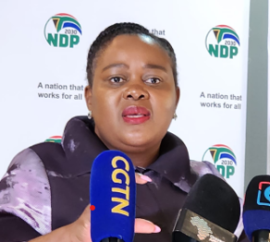
The Madlanga Commission of Inquiry demonstrates government’s commitment to addressing institutional weaknesses and strengthening the capacity of the State, says Justice and Constitutional Development Minister Mmamoloko Kubayi.
Kubayi, who is also co-chairperson of the Justice, Crime Prevention and Security (JCPS) Cluster, addressed the JCPS Cluster and Brand South Africa Media Roundtable at the Nelson Mandela Foundation on Friday.
Kubayi said the inquiry, officially known as the Judicial Commission of Inquiry into Criminality, Political Interference and Corruption in the Criminal Justice System, reflects efforts to "clean up the rot where it exists".
"... [The commission] is also to strengthen our institutions, especially law enforcement institutions, and also the entirety of the architecture of State governance and capacity,” the Minister said.
She explained that one of the priorities under the Medium-Term Development Plan (MTDP) is to build a capable and ethical State.
“... When we look at where we come from in terms of the State capture, there is a need for us to be able to emphasise the importance of ethical leadership,” she said.
Kubayi highlighted that the cluster is tasked with combating crime and corruption, while also restoring confidence for both citizens and investors.
“You can't build confidence in investment when you do not deal with issues such as... fighting crime because those are critical. Now we have developed, in going forward as a cluster, five outcomes that are aligned to the MTDP [and] more broadly, because we are focusing particularly on that area of building capacity to be able to fight crime and corruption in the country," she said.
Part of the JCPS Cluster’s priorities include building safer communities where South Africans feel secure.
“... Part of the priorities that we have to be able to deal with is being able to build safer communities where South Africans feel safe, and one of those areas of feeling safe is to be able to have access to justice, where there's visibility of police, where, when something wrong has happened, there are consequences, and [citizens] can believe in the system," the Minister said.
She noted that the continuation of the Madlanga Commission also reflects observations made by the Zondo Commission on the deliberate weakening and dismantling of key institutions.
“... A continuation of the Madlanga Commission would reflect on what would have been the Zondo Commission's observations on some of the institutions… and we'll account as well, in terms of what we have done to rebuild those institutions,” Kubayi explained.
She outlined progress in several priority areas, including the roll out of the Integrated Persons Management System at police stations to strengthen the identification of suspects and track repeat offenders across provinces.
Other measures include the training of 10 000 new police recruits, the establishment of 21 youth victim-friendly facilities to respond to gender-based violence, and legislative reforms to strengthen bail processes through a review of the Criminal Procedure Act.
On border security, Kubayi pointed to ongoing work under the Border Management Authority and Operation Corona to safeguard South Africa’s borders, and improve coordination between role players. While challenges remain, she said government is determined to distinguish between legal migrants, refugees and illegal immigrants.
“The issue of our porous borders is [part] of the ongoing work that in this administration will target and will ensure that we deal with illegal immigration. People must understand there's a difference between migrants who are here legally - those who have sought refuge and are recognised in terms of international laws, [and we are] also dealing with those who come illegally.
“I don’t think South Africans... don’t welcome people from outside, but it’s and issue that we have to be able to deal with,” Kubayi said. – SAnews.gov.za


