


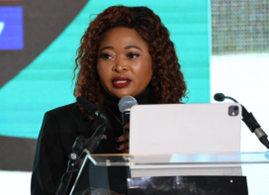
Employment and Labour Deputy Minister Judith Nemadzinga-Tshabalala has expressed concern over what she described as dwindling support for multilateral institutions dedicated to workers' rights.
Delivering the keynote address during the opening of the 4th G20 Employment Working Group (EWG) meeting, Nemadzinga-Tshabalala said the "retreat from collective responsibility strikes at the heart of global labour governance".
“The International Labour Organisation, our indispensable beacon for decent work standards, has been forced to silence the voices of 225 dedicated guardians of social justice through job losses.
“This erosion of capacity within the ILO is not an isolated budgetary concern, but it is also a direct blow to the protective shield for workers everywhere, weakening our shared ability to navigate the complex future of work and undermining the very foundation of fair globalisation. This retreat from funding multilateral pillars signals a dangerous indifference to the architecture of social justice we have built together,” the Deputy Minister said.
The two-day EWG meeting of technical experts ended on Tuesday, and will be followed by a two-day Labour and Employment Ministers' Meeting from 30 - 31 July 2024.
The double header meetings are being held at Fancourt Hotel in George, in the Western Cape. The theme of the G20 EWG stream is: “Living and Working in an Unequal World: Ensuring Decent Work and Decent Lives". It is aligned to South Africa's G20 Presidency theme -- “Solidarity, Equality, Sustainability".
Nemadzinga-Tshabalala said the meeting starts amidst profound transitions, including geopolitical division and escalating trade tensions threatening to unravel decades of carefully woven economic interdependence.
“The harsh reality is that these tensions are not limited to diplomatic chambers or trading floors; they hit hardest on the shop floors, in the fields, and within workers' homes all around the world. When the delicate threads of international cooperation break, it is the world of work that suffers the most. We see this in the breakdown of supply chains, the weaponisation of market access and the weakening of the very institutions meant to support social justice.
“Consider the tremors felt here in Southern Africa. A sudden, severe tariff imposition by a major trading partner has cast a long shadow over our economic landscape. Industries vital to our national livelihood, including automotive manufacturing, agriculture, steel and aluminium, now face an existential challenge," Nemadzinga-Tshabalala said.
She said that this is not merely an economic statistic, but a "quiet panic in communities where entire towns, ecosystems built on decades of trade, now hang precariously in the balance".
The EWG meeting is expected to lay the foundation for the crafting of the Labour and Employment Ministers Meeting (LEMM) declaration.
Deputy Minister told EWG delegates that equality means ensuring that all nations, especially those in the developing world that bear disproportionate burdens from global disruptions, have a fair stake and a powerful voice in shaping the economic rules that govern their destinies.
“Trade policies that devastate developing economies stand in direct contradiction to this principle,” she said.
She further said true sustainability was impossible without stable and predictable international cooperation.
According to the Deputy Minister, when geopolitical rivalry stifles dialogue, the space for vital social dialogue contracts.
She called on the EWG to develop a bold declaration that confronts the full spectrum of the polycrisis – the environmental, technological and social challenges, alongside the insidious geopolitical and trade headwinds that actively undermine global economic stability and workers' security.
The Deputy Minister further said a concrete blueprint advances measurable, actionable commitments.
“Let the Fancourt Declaration be a beacon, demonstrating the G20's unwavering resolve to uphold and strengthen the rules-based international order, explicitly recognising the fundamental link between predictable, fair-trade rules, and stable and dignified employment for all. Trade policy is jobs policy, and its destabilisation is a direct threat to global peace and social cohesion,” she said.
Department of Employment and Labour Acting Director General, Jacky Molisane said the theme of the gathering calls on all to deliver targeted and inclusive implementation of policy responses.
She said the journey travelled so far started with the first EWG meeting under South Africa's G20 Presidency in Gqeberha, and by the time the third meeting was held in Geneva in May, the task had become more focused – initiating the document of the ministerial declaration, advancing negotiations on the gender targets and finalising deliverables for ministerial considerations.
“Our task is clear and urgent. We must conclude negotiations on ministerial declarations, finalise agreement on our deliverables, especially the new targets and the Brisbane-eThekwini gender commitment, and ensure the document is ready," Molisane said.
The G20 EWG's mandate is to address labour, employment and social issues for strong, sustainable, balanced and job-rich growth for all. – SAnews.gov.za


