


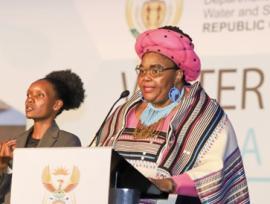
Water and Sanitation Minister Pemmy Majodina says ageing infrastructure, leaks and poor governance are undermining the reliable supply of water.
Speaking to media on the sidelines of the 39th Ordinary Session of the African Union (AU) Assembly of Heads of State and Government in Addis Ababa, Majodina reiterated that the country’s major dams hold sufficient water, but systemic weaknesses in municipal infrastructure are placing water security at risk.
“...As we pump the water, the infrastructure has decayed. The water is leaking and treated water, which is supposed to reach households, is running down the streets,” Majodina said.
The Minister’s remarks come amid ongoing water supply challenges in Johannesburg, where residents have experienced intermittent shortages, low pressure and disruptions linked to a system strain.
Majodina explained that her department’s constitutional mandate is primarily focused on bulk water resource development, including building dams, tunnels and canals, while municipalities are responsible for reticulation and distribution.
However, national government has stepped in to support local interventions, where possible.
She said working with Rand Water, government has invested in major bulk infrastructure, including upgrades to the Zuikerbosch Water Treatment Works System, one of the largest facilities in the country.
“That plant has the capacity not only to supply [to] South Africa but even to provide treated water to neighbouring countries,” the Minister said.
The core problem, she stressed, lies in municipal infrastructure that has not kept pace with rapid urban growth.
“When you drive through Johannesburg, you see water flowing in the streets. That is treated water. It is not reaching the taps because pipes are leaking,” Majodina said.
Consumption
The Minister also noted that South Africa’s per capita water consumption far exceeds international norms. While the global benchmark stands at approximately 173 litres per person per day, South Africa’s consumption has been recorded at around 239 litres per person per day.
“That is abnormal. If we continue at that rate, we are going to collapse the system,” she warned.
To stabilise supply in Johannesburg, she said authorities have implemented load shifting between pump stations and introduced “water soft locking”, a measure to reduce water pressure across the system.
“Soft locking does not mean people will not have water. It means we reduce the pressure so that those who are not getting water can receive supply,” Majodina explained.
She said municipalities have been advised to increase reservoir storage capacity and ring-fence water revenue to reinvest in infrastructure maintenance and upgrades.
“We have told municipalities to ring-fence water sales and invest back into water infrastructure. They have not done so. Today, some systems have collapsed because they do not have engineers and scientists,” she said.
Illegal connections and vandalism
Majodina further raised concern about illegal connections, vandalism and so-called “water mafias”, who tamper with infrastructure.
“Our infrastructure is vandalised day in and day out. Illegal connections are contributing to losses and destabilising the system.”
The Minister highlighted the significance of the proposed Water Services Amendment Bill, which seeks to separate the roles of water services authorities and water services providers.
“Currently, in many municipalities, you are both the referee and the player at the same time (sic). There is no oversight. If systems fail, no one is held accountable,” she said.
Majodina said the amendment bill will enable clearer governance distinctions and strengthen national government’s ability to intervene where service delivery collapses, a power currently limited under constitutional provisions that assign water services to local government.
Groundwater development
Looking ahead, she said government will intensify its focus on groundwater development, particularly in underserved communities that have never had access to clean piped water.
“We have not fully tapped into groundwater potential, especially for communities that have never received a drop of clean water,” she said.
While acknowledging that water challenges extend beyond South Africa to the broader continent, Majodina maintained that the country’s immediate priority is fixing infrastructure, strengthening governance, and restoring public confidence.
Meanwhile, Majodina has welcomed President Cyril Ramaphosa’s recent commitment to chair the National Water Crisis Committee, describing it as a crucial step in elevating water reform to the highest level of government. – SAnews.gov.za


