


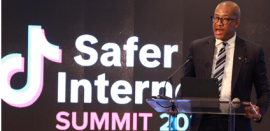
Deputy Minister in the Presidency Kenny Morolong has called for a collective African approach to tackling one of the defining governance challenges of the 21st century: information integrity.
The Deputy Minister delivered an address at the 2026 TikTok Safer Internet Summit held in Nairobi, Kenya, on Tuesday.
Drawing on the work of historian Yuval Harari, Morolong warned that although social media platforms present opportunities, these networks have evolved into a part of a “new digital bureaucracy”.
“[Today] humanity has created a new form of bureaucracy: the global digital network; algorithms that shape how billions of people receive and consume information every single day, power this bureaucracy.
“Social media platforms – including TikTok – are now part of this new digital bureaucracy. They organise attention, distribute narratives, amplify voices and influence how societies understand or perceive the truth, authority and reality itself.
“This, therefore, makes information integrity one of the defining governance challenges of the 21st century,” he noted.
Pressing further, Morolong emphasised that the platforms can also be used to spread destructive messages.
He argued that because digital networks operate “faster and further than any previous communication system”, these harms are more “powerful and relentless than anything societies have experienced before”.
“While we acknowledge how digital networks can spread knowledge, creativity and opportunity, we must accept that they also spread something far more dangerous: misinformation, disinformation and malinformation.
“These three forms of harmful information have different origins but the same destructive impact. Together, they undermine trust in institutions, polarise communities and threaten democratic stability,” the Deputy Minister said.
Government action
To counter these threats, Morolong pointed to existing national and regional frameworks in recognition of the “importance of responsible communication in a democracy”.
For its part, the Government Communication and Information System (GCIS) has adopted the National Communication Strategy Framework 2025 – 2030, which emphasises “coordinated, credible and citizen-centred communication across all spheres of government”.
“[The] South African government, through the National Communication Strategy Framework recognises that communication is not simply about messaging. It is about building trust between the State and the people.
“If we accept this to be true, then we should accept that information integrity is not merely a technical issue. It is a development issue. It is a governance issue. It is a democratic issue,” Morolong told the gathering.
The Southern African Development Community Protocol on Communications calls on its Member States to “develop efficient, integrated and coordinated communication systems that support economic growth and social development across the region”.
“The protocol recognises that communications infrastructure and services are strategic assets that must serve the collective interests of societies and strengthen regional cooperation,” the Deputy Minister said.
Working together
Morolong suggested three areas where platforms like TikTok can lead global innovation:
- Responsible use of algorithms: Algorithms should not only optimise engagement. They should also actively identify and reduce the amplification of demonstrably false or harmful content.
- Information transparency: Users must understand how information reaches them. Greater transparency around recommendation systems, content moderation and information verification can help rebuild public trust in digital platforms.
- Digital literacy partnerships: Platforms must work closely with governments, educators and civil society to equip citizens, especially young people, with the tools to recognise misinformation and verify information sources.
He clarified that the push for safer digital spaces is about responsible stewardship, not suppression of voices.
“This is not a call for censorship. It is a call for responsible stewardship of the digital public sphere. The challenge before us is to ensure that the new bureaucracy of computer-based networks serves humanity rather than destabilising it.
“We have to be deliberate and ensure we put enough guardrails, especially for the vulnerable sections of society: the elderly, the disabled and children.
“Let this summit mark a new chapter of cooperation between platforms like TikTok and governments across the great and beautiful continent of Africa,” Morolong concluded. – SAnews.gov.za


