


The South African Government has settled 83 721 land claims at 31 December 2025, through its Restitution Programme, benefiting more than 2.3 million people and 468 761 households.
Of these beneficiaries, 181 411 were female-headed households and 1 291 were households headed by persons living with disabilities.
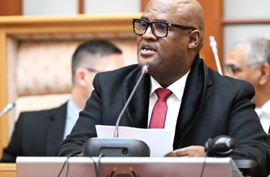
Presenting the department’s Budget Vote for 2026/27 financial year on Wednesday, Land Reform and Rural Development Minister, Mzwanele Nyhontso, reiterated that the Restitution Programme remains central to addressing land dispossession caused by racially discriminatory laws and practices implemented after 19 June 1913.
The Minister highlighted that since its inception in 1995, the Restitution Programme has seen the restoration of approximately 3 916 733 million hectares of land to beneficiaries at a cost of around R27 billion.
“In addition, approximately R27.6 billion has been paid as financial compensation to qualifying beneficiaries, while approximately R5.5 billion has been allocated in the form of development grants in terms of section 42C of the Restitution of Land Rights Act, 22 of 1994 (as amended).”
The Minister added that the Commission on Restitution of Land Rights plans to settle 307 claims and finalise 284 during the 2026/27 financial year. The number of outstanding old order land claims currently stands at 5 245.
“The Commission has been allocated approximately R3.839 billion for the current financial year. This allocation supports compensation of employees, operational requirements, transfers to households, and capital expenditure necessary for restitution implementation.”
Modernising land administration
The Minister said the department will during the current financial year continue implementing the Electronic Deeds Registration System (eDRS), as part of broader efforts to modernise land registration systems.
He emphasised that the Land Administration function is central to property rights, investment certainty, land development, and integrated public administration.
“As one of the key functions in this area, Deeds Registration continues to provide legal certainty in relation to registered rights in land and property, and it supports housing delivery, municipal administration, infrastructure investment, and broader economic activity.”
The department will also continue to strengthen cadastral survey processing and maintaining the integrity of land parcel information required for orderly development and secure property registration.
The Minister said the National Geomatics Management Services function remains essential to land administration, infrastructure development, geospatial coordination, investment certainty, and spatial planning.
“A significant development, which also underscores our country’s growing international footprint, is that the 28th International Federation of Surveyors (FIG) Congress 2026 and General Assembly is to be held in Cape Town from 24 to 29 May 2026.
“This is the largest such event in the world, which attracts around 1 200 to 1 500 experts in land surveying, geospatial sciences, spatial planning, construction management, and valuation,” the Minister said.
Spatial planning reforms continue
Nyhontso said government would continue implementing the National Spatial Development Framework 2050 and developing the National Spatial Data Observatory to improve planning and infrastructure coordination.
The department is also finalising amendments to the Spatial Planning and Land Use Management Act (SPLUMA) and the Planning Profession Act to strengthen implementation, institutional effectiveness, and professional standards.
“We are aware of the uneasiness that many traditional leaders have expressed with regard to SPLUMA, and this is another area in which we are committed to facilitate a process of dialogue and seeking solutions, as we consider this area to be critical to land administration and development in the communal rural areas.
“Support to provinces and municipalities will continue through assistance relating to spatial development frameworks, wall-to-wall land use schemes, municipal bylaws, and broader land use management implementation support,’ the Minister said.
The department will further continue to expand the Drone Remote Sensing Programme and to develop climate-responsive land use management norms and standards aligned to the SPLUMA and the Climate Change Act, 22 of 2024. – SAnews.gov.za


