


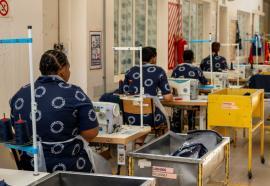
Minister of Correctional Services, Dr Pieter Groenewald, says that the country’s Self-Sufficiency and Sustainability Strategic Framework (SSSF) not only creates employment opportunities for offenders in farms, bakeries, gardens, and abattoirs, but also empowers them.
“Enabling them to produce their own food has not only empowered the offenders but also resulted in considerable savings for the South African government, “ the Minister said.
The Minister believes this demonstrates how the United Nations Standard Minimum Rules for the Treatment of Prisoners, known as the Nelson Mandela Rules, can be effectively implemented.
The Minister believes that this is one of several successful examples demonstrating how the implementation of the Nelson Mandela Rules can lead to transformative outcomes.
These outcomes equip offenders with the necessary skills and experiences to become economically independent after their rehabilitation and reintegration into society.
The Minister spoke at the 34th Session of the United Nations (UN) Commission on Crime Prevention and Criminal Justice (CCPCI) held in Vienna, Austria.
This as the international community also celebrated the 10th anniversary of the rules.
The revised Nelson Mandela Rules were adopted unanimously in December 2015 by the UN General Assembly and set out the minimum standards for good prison management, including ensuring that the rights of prisoners are respected.
The Minister also took the time to urge world leaders to honour the enduring legacy of President Nelson Mandela, who was in prison for 27 years for his activism against apartheid, and the ideals of dignity, justice, and human rights that he stood for.
In addition, he called for the international community to advance a more just, inclusive, and rehabilitative approach to incarceration.
“In light of rising global prison populations, systemic overcrowding, and the urgent need for more humane and effective penal systems, the 10th Anniversary of the Nelson Mandela Rules provides a timely platform to underscore the importance of prison and penal reform.”
The Minister also took the time to urge world leaders to honour the enduring legacy of President Mandela and the ideals of dignity, justice, and human rights that he stood for.
He also took the time to acknowledge the commemoration of the 10th Anniversary of the Nelson Mandela Rules at the UN General Assembly High-Level Debate, scheduled for 13 June 2025.
The theme of the debate is “A Second Chance: Addressing the Global Prison Challenge.”
The Minister expressed support for the Bangkok Rules, which complement the Nelson Mandela Rules by addressing the specific needs and circumstances of women in the criminal justice system, requiring gender-sensitive approaches to their treatment and rehabilitation.
“Together, these two sets of international standards promote a more inclusive, equitable, and human rights–based correctional system that respects the dignity of all individuals,” he explained.
He congratulated Japan on successfully adopting the Model Strategies to Reduce Reoffending, which further supports the Nelson Mandela Rules by ensuring that rehabilitation and reintegration principles are effectively realised beyond prison walls.
“We wish to express our sincere gratitude to the UNODC [United Nations Office on Drugs and Crime] for their efforts in promoting the practical application of the rules and encourage them to continue assisting Member States in seeking innovative ways to address prison management and penal reform.”
He concluded his talk by quoting Nelson Mandela, who aptly said, “No one truly knows a nation until one has been inside its jails. A nation should not be judged by how it treats its highest citizens, but its lowest ones.” – SAnews.gov.za


