


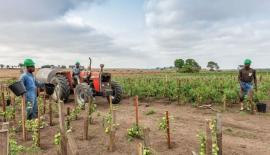
Government is intensifying efforts to accelerate land reform, strengthen tenure security and modernise land administration systems as part of efforts to address historical inequalities and rural underdevelopment.
This is according to Minister of Land Reform and Rural Development, Mzwanele Nyhontso, who presented the department’s Budget Vote in the National Assembly on Wednesday.
Nyhontso said the department’s work remains focused on equitable access to land, restitution of land rights, sustainable rural livelihoods and improved spatial governance.
“These responsibilities remain central to addressing the historical legacies of dispossession, poverty, inequality, exclusion, underdevelopment and uneven spatial development,” he said.
Over the medium term, the department has been allocated approximately R32.1 billion, with R10.336 billion set aside for the 2026/27 financial year.
About 20 000 hectares of land allocated to women
Nyhontso said the department had acquired approximately 53 000 hectares of land during the reporting period and allocated more than 35 000 hectares to qualifying individuals and communities.
“In line with the Cabinet-approved Beneficiary Selection and Land Allocation Policy, approximately 20 000 hectares of land were allocated to women and 13 000 hectares to youth beneficiaries,” the Minister said.
The Minister said government will continue prioritising equitable access to land for women, youth, persons with disabilities and other qualifying beneficiaries.
In efforts to strengthen tenure security, the Minister reported that approximately 7 000 hectares were acquired and transferred to more than 700 farm dwellers and labour tenants.
He added that 61 labour tenant matters had been finalised with the support of the Special Master on Labour Tenants, while 313 matters were referred to court where negotiations could not be concluded successfully.
“Additionally, approximately 206 000 hectares of land were transferred from the State to affected communities through the implementation of the Transformation of Certain Rural Areas Act, 94 of 1998.”
Land audit
Nyhontso announced that government is preparing to undertake a Comprehensive Land Audit, to amend the Beneficiary Selection and Allocation Policy for beneficiaries of the Proactive Land Acquisition Strategy (PLAS).
One of the key objectives of the Comprehensive Land Audit is to develop the necessary policies and legislation to give effect to the Constitutional mandates on equitable access to land, communal land tenure and administration, rural development, and land administration.
“We have also identified the rationalisation of apartheid laws as a long-standing factor that continues to complicate the work of the department in discharging its land reform mandate, as many such laws that still exist on the Statute Book are in direct conflict with the Constitution. This work is to be conducted under the auspices of a retired judge whose appointment process is underway,” Nyhontso said.
The Comprehensive Land Audit will also bring certainty about who owns what land in South Africa, in terms of race, gender, business entity, land held in trusts, regional distribution, as well as nationality.
New land reform legislation
The Minister said the Equitable Access to Land Bill, intended to give effect to Section 25(5) of the Constitution, will become the centrepiece of the Redistribution Programme.
Section 25 (5) of the Constitution speaks to the State taking reasonable legislative and other measures, within its available resources, to foster conditions which enable citizens to gain access to land on an equitable basis.
The proposed legislation includes the establishment of a Land Reform Agency focused on land and beneficiary identification, allocation and post-settlement support.
Nyhontso said the bill is expected to be presented to Cabinet before public consultations by June this year.
The Minister also confirmed that the Communal Land Tenure and Administration Bill is on track to be submitted to Cabinet and opened for public consultation by the end of June this year.
“This Bill seeks to address not only the Constitutionally mandated function of ensuring legally secure tenure for the millions of residents of the former homelands and other communal areas.
“It also seeks to introduce a sustainable, democratic, gender and youth empowering system of communal land administration in which communities and traditional leaders will work together in a mutually supportive manner,” he explained.
Concerns over communal property associations
Nyhontso acknowledged ongoing governance and functionality challenges affecting Communal Property Associations (CPAs).
He said tensions between communities and traditional leaders remain a concern, adding that government is working to strengthen governance systems and institutional arrangements.
During the reporting period, the department exceeded its target for CPA training by equipping 821 executives with governance, financial management and land administration skills.
Ministerial roadshows were also conducted across all provinces, engaging 507 CPAs and approximately 2 465 members.
“These engagements consistently raised concerns relating to governance instability, internal disputes, business unsustainability, inadequate or no post-settlement support, lack of proper accountability systems, and poor relationships between CPAs and traditional institutions,” the Minister said.
He added that an Indaba on the National CPA will be held during the course of the year. – SAnews.gov.za


