


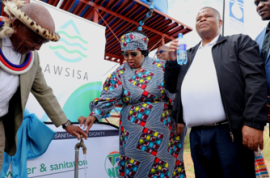
The South African government has reaffirmed its commitment to expanding access to water and addressing persistent supply challenges.
This as the Department of Water and Sanitation handed over a newly completed borehole to the Sokhulumi community in Bronkhorstspruit on Friday.
Speaking during the handover at the Indlu Yokuthula Service Centre, Water and Sanitation Minister Pemmy Majodina said the project forms part of broader government interventions aimed at strengthening water security and improving access to basic services in communities that continue to face supply interruptions.
The borehole - delivered during National Water Month and in the lead-up to International Women’s Day and Human Rights Day commemorations - is intended to provide a reliable water source for residents while also easing the burden on households that have struggled with inconsistent supply.
Majodina said the intervention goes beyond the delivery of infrastructure, highlighting government’s efforts to restore dignity, improve public health and bring services closer to communities.
WATCH |
She noted that for many South Africans, particularly women in rural and peri-urban areas, water insecurity remains a daily reality, often requiring long walks to collect water and placing additional strain on households.
According to the Minister, the Sokhulumi borehole is part of ongoing government programmes to expand reliable access to water through sustainable water, sanitation and hygiene initiatives.
The intervention is also linked to the department’s International Women’s Day 2026 Ministerial Engagement and Water Month flagship programme.
Government has acknowledged that while significant progress has been made since the advent of democracy in 1994, challenges persist across the water sector. Majodina said millions of households previously excluded under apartheid have since been connected to basic water services through expanded bulk infrastructure, new dams and rural water schemes.
However, she conceded that ageing infrastructure, rapid urbanisation, climate variability, vandalism and governance weaknesses have placed increasing pressure on water systems in several areas.
These factors, combined with South Africa’s status as a water-scarce country with limited rainfall and unevenly distributed resources, have contributed to ongoing supply constraints.
The Minister said targeted interventions such as the Sokhulumi borehole demonstrate government’s efforts to respond to local needs while building resilience against disruptions in supply.
“This intervention strengthens water security and shows that government listens and acts,” she said, adding that ensuring reliable access to water remains central to fulfilling the constitutional right to sufficient water.
Beyond infrastructure delivery, government is also using the initiative to advance its Sector Wide Women in Water Programmatic Approach for 2026 to 2030.
The framework aims to promote women’s participation and leadership across the water and sanitation sector, including expanding skills development opportunities for young women and supporting women-owned enterprises within the water value chain.
Majodina said improving water access is closely linked to broader social outcomes, including better healthcare services, improved school attendance and stronger livelihoods for households.
She added that government is also preparing for future pressures on the water system by prioritising maintenance, diversifying water supply sources, reducing leaks and promoting water conservation as part of long-term planning.
The Minister called on communities to play a role in protecting water infrastructure, reporting leaks and illegal connections, and using water responsibly, emphasising that water security requires cooperation between government and citizens.
She said the handover in Sokhulumi serves as both a symbol of progress and a reminder that government must continue accelerating delivery in areas where service backlogs remain. – SAnews.gov.za


