


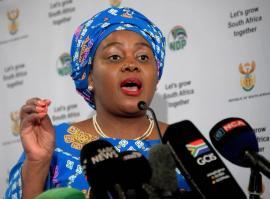
Justice and Constitutional Development Minister Mmamoloko Kubayi says “significant progress” has been made on the work to transition the Judiciary towards administrative and operational independence.
The Minister made the remarks during a webinar hosted by judicial monitoring body, Judges Matter.
Earlier this year, President Cyril Ramaphosa, together with members of the National Executive, hosted a high-level engagement with Constitutional Court Chief Justice Mandisa Maya and Heads of Court to kick start the process to entrenching the independence of the Judiciary.
The proposed model will entail structural independence, which includes both financial and operational independence with the vision to establish a single Judiciary, the administration of the Lower Courts, including the Magistrates Commission, will also be transferred the Office of the Chief Justice (OCJ).
During the dialogue with Judges Matter, Kubayi outlined the progress made so far with the transfer of functions to be conducted in phases.
“Since the formation of the task team to work on the transition to an administrative and operationally independent Judiciary, significant progress has been made to make this vision a reality.
“Phase 1 will involve the immediate transfer of shared services relating to the Superior Courts from the Department to the OCJ. These shared services are not provided for in any legislative instrument and the transfer could be effected through a directive from the Minister to the Accounting Officers of the Department and the OCJ. Phase 1 transfer will be effective from 01 April 2026.
“Phase 2 involves, amongst others, the operationalisation of legislation aimed at clothing the Judiciary with full institutional independence including the creation of a single Judiciary. With regards to Phase 2, it is envisaged that the team will have the first draft bill before the end of this year,” she said.
Kubayi noted that the transfer of District and Regional courts to the OCJ “may be a complex matter”.
“However, in line with the vision of creating a single judiciary, we believe the transfer of the lower courts to the OCJ will make the judiciary stronger and independent as a third arm of the state.
“To this effect, an audit of court-related functions to be transferred to the OCJ has been conducted which indicated that the magistrate commission and various functions performed in respect of court operations at national and provincial level should be transferred to the OCJ,” she added.
Gaining independence
Kubayi explained that under a dispensation similar to that of Parliament, it will be proposed that secretary general of the judiciary will appear before Parliament to “account for the finances”.
“The enabling legislation must provide for financial and operational independence of the superior courts administration promoting governance mechanisms and appropriate checks and balances. OCJ should be a permanent independent entity separate from the Executive authority under the aegis of the Judiciary.
“OCJ will be required to administer and provide support to the courts generally, including but not limited to the provision of, information technology services; corporate and logistic services; case flow management; infrastructure services and resource management; operational support; management and maintenance services in respect of court buildings and OCJ offices and premises, including court libraries and other facilities.
“They also be required to manage human resources; and manage the budgeting and accounting of the courts and the OCJ,” the Minister said.
She reiterated government’s support for the process, stressing that South Africa's courts, especially the Constitutional Court, have been able to be a steady voice, grounded in reason, compassion and principle without interference from the executive, even in cases where the executive vehemently disagreed with the decisions courts.
“The debate on judicial governance and court administration within the context of an independent Judiciary has been ongoing since the advent of democracy. The principles of the separation of powers and the independence of the judiciary lie at the heart of this debate.
“I would like to reaffirm, on behalf of the executive, our commitment to safeguarding and supporting the independence of the judiciary. We also committed to the creation of a single judiciary that is administratively and operationally independent and led by the judiciary,” Kubayi concluded. – SAnews.gov.za


