


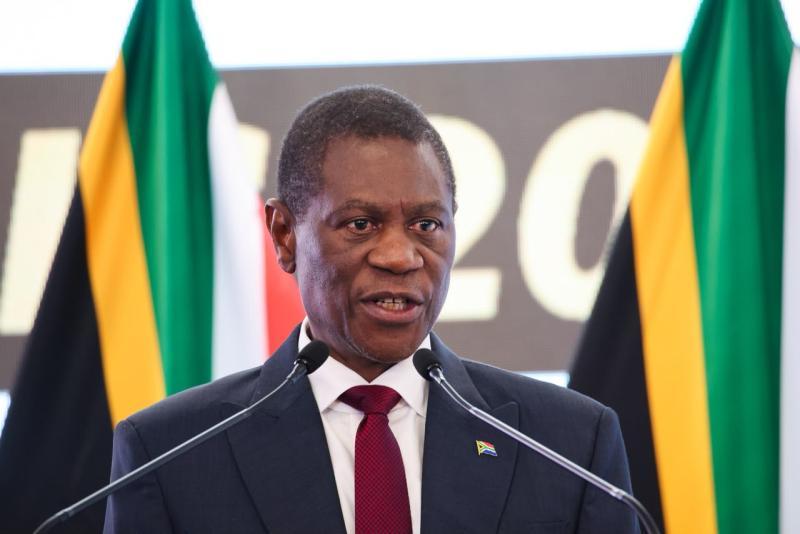
South Africa must move beyond policy promises and awareness campaigns to deliver real protection for the more than one in three women who still face physical or sexual violence in their lifetime.
That was the clear message from Acting President Paul Mashatile on Friday as he launched the 2026 16 Days of Activism campaign in Middelburg, Mpumalanga, calling for stronger accountability and practical action across every tier of government.
The campaign officially runs from 25 November to 10 December under the theme: “Letsema: Men, Women, Boys and Girls working together to end Gender-Based Violence and Femicide”.
The Deputy President said the country can no longer rely on awareness campaigns and policy commitments without tangible improvements in the lives of women and children.
“This occasion must be about responsibility, accountability, and practical change.
“We owe the women and children of South Africa a response measured not by what we announce, but by what actually changes in their daily lives,” he said.
Mashatile noted that the Human Sciences Research Council’s first national gender-based violence study found that more than one in three adult women in South Africa have experienced physical or sexual violence in their lifetime.
He said the findings highlight the scale of the crisis and the need for government to strengthen its response.
The National Strategic Plan
The five-year review of the National Strategic Plan (NSP) on GBVF also showed that significant work continues, with 65 of the 191 indicators assessed being achieved, while 104 are still in progress, and 22 being missed.
The Deputy President said that “most concerningly”, only six of the 42 targets relating to prevention and social cohesion have been achieved.
To address these gaps, Mashatile said President Cyril Ramaphosa announced four immediate national interventions on 29 September to accelerate implementation of the NSP.
The first is a National Case-Recovery Operation, under which law enforcement and justice institutions must review unresolved murders, attempted murders, rapes and serious sexual offences involving women and children.
The operation seeks to establish why cases have stalled, address gaps in evidence, and ensure clear accountability.
The second intervention focuses on eliminating forensic backlogs through a funded reduction plan, clear turnaround standards, and prioritised processing of forensic evidence in rape and murder cases involving women and children.
The third requires women’s safety audits in every municipality to identify risks such as poor street lighting, unsafe transport routes, abandoned buildings and neglected public spaces.
Municipalities must work with communities, law enforcement, and provincial authorities to incorporate corrective measures into funded plans with clear timelines. Communities must also be able to see what risks have been identified and what action has been taken.
The fourth intervention targets alcohol-related violence through coordinated legislative, regulatory and enforcement response, including stronger action against unlawful liquor trading and expanded support services to reduce alcohol-related harm.
“While alcohol can never excuse violent behaviour, and responsibility rests solely with perpetrators, evidence shows that harmful alcohol use is a major contributing factor in many incidents of violence,” Mashatile said.
He said these interventions require effective implementation by provinces and municipalities, supported by a common accountability framework.
To strengthen national coordination and oversight of the GBVF response, the Department of Women, Youth and Persons with Disabilities has been allocated an additional R157.4 million over the medium-term following engagements with National Treasury.
The investment aims to support the expansion of courts, care centres, and social work capacity.
The Deputy President, however, acknowledged the need for sustained funding towards the full NSP and GBVF disaster response implementation.
Protecting dignity
The launch was marked by the opening of a new Thuthuzela Care Centre at King Nyabela Hospital, earlier in the day.
The centre brings medical care, counselling and legal support together under one roof, with trained professionals providing assistance in a private and supportive environment.
Mashatile said facilities like these are important in ensuring that survivors are treated with dignity, and do not have to repeatedly recount their experiences while seeking help.
He called on national departments to clarify their responsibilities and report honestly on delivery, while provincial administrations translate national directives into practical programmes that respond to community needs.
“To municipalities, make safety visible in your budgets, maintenance programmes, and public spaces. To law-enforcement and Justice Institutions, protect the integrity of cases and the dignity of survivors. To the National Council on GBVF and social partners, promote public accountability and sustain a whole-of-society response.
“Let us leave Middelburg determined that our next report would contain more than activities completed and meetings convened.
“It must tell us that more survivors received timely care; that unresolved cases are moved forward; that unsafe spaces were repaired, that children found protection, and that our communities became places where women and girls live freely,” the Deputy President said. – SAnews.gov.za


