


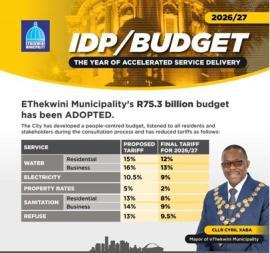
The eThekwini Council has officially adopted the Municipality’s 2026/2027 Medium-Term Revenue and Expenditure Framework (MTREF), approving a R75.3 billion budget aimed at accelerating service delivery, renewing infrastructure, and advancing turnaround strategies for the city’s trading services.
The adopted budget comprises an operating budget of approximately R69 billion and a capital budget of R6.3 billion. The budget was developed within an overall planning framework aligned to the city’s strategic objectives, with a strong focus on sustainable service delivery and long-term financial stability.
Addressing Council during the adoption of the budget, eThekwini Mayor Cyril Xaba said the budget represents a practical and sustainable financial plan for the city.
“The 2026/2027 budget is not an aspirational document. It is a funded, credible, and sustainable plan, assessed as such by National Treasury. It prioritises the acceleration of repairs, the upgrading of bulk infrastructure, and the full implementation of our trading services turnaround strategies,” Xaba said.
Xaba said the budget followed an extensive public participation process after the draft budget was tabled in March 2026. Between 13 April and 11 May 2026, the city hosted 12 public budget hearings, including dedicated engagements with business stakeholders, disability organisations, and ratepayer associations, as well as regional hearings covering all municipal wards.
“The hearings were well attended, with most inputs reflecting the real challenges faced by our communities. The process was widely advertised through radio, print, and social media, inviting public participation and written submissions,” he said.
The city noted that several public inputs were incorporated into the final budget to provide relief to residents amid ongoing economic pressures.
“As a result, we have made meaningful adjustments to the draft budget. However, not all requests could be accommodated within the available financial envelope. This budget therefore balances service delivery, infrastructure renewal, job creation, affordability, and financial sustainability,” the mayor said.
Following engagements with stakeholders and national government, Council approved revised tariff increases for the 2026/2027 financial year, including reductions to the proposed increases for water, sanitation, electricity, refuse removal, and property rates.
The revised tariff adjustments are as follows:
• Domestic water tariff increase reduced from 15% to 12%
• Business water tariff increase reduced from 16% to 13%
• Domestic sanitation tariff increase reduced from 13% to 8%
• Business sanitation tariff increase reduced from 14% to 9%
• Average property rates increase reduced from 5% to 2%
• Refuse tariff increase reduced from 13% to 9.5%
• Electricity tariff increase reduced from 10.5% to 9%
Xaba said the revised tariffs are intended to provide much-needed relief to residents and businesses.
“As a caring city, we certainly hope that this brings some relief to our ratepayers and consumers,” he said.
Council also approved amendments to the City’s Indigent Support Policy to ensure more targeted assistance for vulnerable households.
The threshold for exemption from property rates for indigent households has been increased from R350 000 to R400 000, while pensioner rebate qualification thresholds have been raised from R2.5 million to R2.75 million.
The Mayor said the main sources of funding for the operating budget are service charges, property rates, and grants and levies. Key areas of expenditure include bulk purchases, employee-related costs, contracted services, and operational expenditure.
The adopted budget places significant emphasis on upgrading ageing infrastructure, improving the reliability of water, sanitation, and energy services, and driving spatial transformation initiatives across the city.
“The main focus of the budget is to ensure efficient and effective service delivery to our residents in order to uplift their quality of life,” he said.
Improved access to basic, infrastructure services
The Mayor highlighted the significant progress made over the past five years, including improved access to basic services and major infrastructure delivery.
“There has been improved access to basic services, with more than 21 000 new electricity connections, mostly in previously underserved areas, bringing electricity coverage to almost 100%.
“We have built 7 910 housing units and issued 3 200 title deeds, restoring dignity and providing security of tenure to families who previously had no shelter, and we have successfully rehabilitated more than 500 kilometres of roads,” the mayor said.
An emphasis has also been placed on good governance and internal controls to drive productivity and value for money.
This includes interventions to reduce overtime abuse, improve response times, and the use of artificial intelligence and digitalisation to improve efficiency and effectiveness. – SAnews.gov.za


