


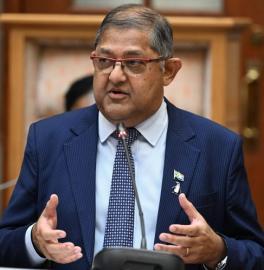
Deputy Minister of Forestry, Fisheries and the Environment Narend Singh says government is not only creating job opportunities for young people, but also building the next generation of environmental professionals.
“During the 2025/26 financial year, the Department of Forestry, Fisheries and the Environment strengthened its youth employment pipeline through graduate-focused interventions implemented across Environmental Programmes,” the Deputy Minister said on Tuesday, in Parliament, during the Budget Vote.
During that year, these interventions supported 6 083 young people and graduates by providing structured exposure to environmental work, service delivery support, and practical workplace experience.
“A key part of this work is the Municipal Environmental Graduates Programme, which commenced in August 2025. The programme was introduced to respond to two linked challenges: youth unemployment and limited environmental capacity within local government,” Singh said.
Through this programme, 430 environmental graduates were initially placed in municipalities for a 24-month period.
Following a positive response and the clear need for further support, an additional 110 graduates joined the programme in February 2026, bringing the total number of Municipal Environmental Graduates to 540 across 205 local municipalities.
These graduates assist municipalities with environmental planning, compliance, waste management, climate resilience, biodiversity initiatives, community awareness, and the integration of environmental priorities into Integrated Development Plans.
“Importantly, this intervention carries directly into the 2026/27 financial year and will continue until July 2027. For the current financial year, the department is projecting a further 3 897 youth and graduate opportunities across Environmental Programmes with a total investment budget of R83 824 535.36 million, ensuring that this pipeline of skills, experience and employability is sustained,” he said.
He added that this demonstrates how the department is moving beyond temporary relief.
“We are creating work experience, strengthening municipalities and building a pool of young environmental practitioners who can contribute meaningfully to South Africa’s green economy,” the Deputy Minister said.
Key programmes include Working for Water, which clears invasive alien plants that threaten biodiversity and reduce water availability.
In 2026/27, the department will clear 159.878 hectares while also enhancing community participation, awareness, collaboration, and regulation.
Furthermore, Working on Waste, implemented in partnership with the local government, will create more than 10 000 work opportunities.
The programme tackles littering and illegal dumping, helps transform towns and cities into cleaner spaces, and supports local economic development.
Working for the Coast enables vulnerable coastal communities to protect the coastline through litter picking and waste removal, preventing plastic from harming marine life and safeguarding both environmental and human health.
Meanwhile, the department is reviewing the Environmental Impact Assessment (EIA) procedures to better align them with the National Environmental Management Act, while maintaining a commitment to timely support for strategic infrastructure, energy security, and economic development projects. -SAnews.gov.za


