


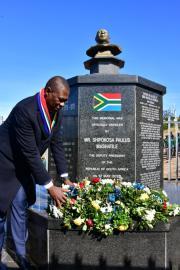
While honouring the heritage of traditional leadership in the fight against colonialism, Deputy President Paul Mashatile has underscored that traditional leadership should not be confined to preserving heritage alone, but must also play an active role in addressing pressing challenges such as service delivery failures, socio-economic development, youth empowerment, and gender equality.
“We gather here with a clear and urgent task before us: to advance land rights and socio-economic development, to strengthen traditional institutions, to invest in infrastructure and skills, to promote nation-building and unity, and to finalise the policy and legislative reforms that our people have long awaited,” the Deputy President said on Tuesday.
Mashatile was speaking at the 191st Anniversary Commemoration of Hintsa kaKhawuta, where he paid tribute to traditional leaders and warriors who died fighting for land and sovereignty during the wars of dispossession between the Xhosa Kingdom and colonial forces.
The Deputy President drew parallels between the role traditional leaders played in resisting colonial domination and their role in a democratic society today, using history to reaffirm the importance of traditional leadership in advancing social cohesion, development, and nation-building.
“As leaders of our people, mostly in rural areas, you stand at the forefront of rural renewal, advocating for investment in agriculture, infrastructure, and education.
“We cannot ignore the cry of our people when municipalities falter. When taps run dry, when roads remain broken, and when housing projects stall, these are not mere service delivery failures. They are violations of human dignity,” Mashatile said.
He called on traditional leaders to use platforms such as the National House of Traditional and Khoi-San Leaders, as well as Provincial and Local Houses, to participate in shaping policies that affect rural communities.
“It is through these structures that traditional leaders have consistently raised critical issues, including land rights, socio-economic development, institutional capacity, infrastructure support, policy reforms, and social cohesion.
“These challenges do not diminish traditional leaders’ relevance. They call us instead to strengthen collaboration between Traditional Councils and Municipalities, to ensure that service delivery is not delayed, and to ensure that the dignity of our people is not denied,” he said.
The Deputy President advocated for government and traditional leaders to establish a covenant of renewal, intertwining heritage and progress, ensuring that land is managed with transparency, that communities are empowered with opportunity, and that governance is measured not by privilege but by service.
“King Hintsa's life teaches that genuine leadership is defined by selfless service to the community, rather than privilege or corruption. In his honour, we should unite to restore integrity in governance and address the people's needs,” the Deputy President said.
The year 2026 marks the 191st anniversary of King Hintsa’s assassination by British colonial forces on 12 May 1835 at the Nqabarha River.
The King was a pivotal figure in the defence of his ancestral land against colonial encroachment.
“Commemorating this anniversary is significant as it honours his legacy as a unifier and courageous leader who sacrificed his life to protect amaXhosa sovereignty and land from colonial expansion.
“Furthermore, the 191st anniversary commemoration of Kumkani Hintsa holds deep significance as it honours a pivotal figure in the struggle against colonialism, aligning with the overall objectives of Africa Month,” the Deputy President said.
By celebrating Africa Month by commemorating the life of King Kumkani Hintsa, the Deputy President said the 191st anniversary reinforces the collective consciousness and shared history of resistance among Africans.
“Celebrating Traditional Leaders and warriors who passed away during the Eastern Cape Frontier Wars (1779–1879) is essential for reclaiming Indigenous history, fostering national identity, and acknowledging the profound sacrifices made in defense of land and sovereignty.
“These wars of dispossession, lasting a century between the Xhosa Kingdom and colonial forces, represent the longest military resistance against European colonialism in Africa,” he said.
In celebrating the life of the King, a memorial was unveiled near the N2 road, honouring Kumkani Hintsa for his significant role in defending his ancestral land and achieving freedom and democracy.
“His epitaph reflects his qualities of selflessness, courage, and devotion to his people, emphasising that his life and death were focused on upholding the dignity, land, and future of the Xhosa nation rather than personal gain or glory.
“Erecting memorials for local heroes is crucial in reshaping the post-apartheid landscape, fostering national reconciliation, and reclaiming history for the marginalised.
“These memorials serve to honour those lost in conflict, enhance social cohesion, and fulfil educational roles, ultimately contributing to a shared identity among diverse communities,” the Deputy President said. -SAnews.gov.za


