


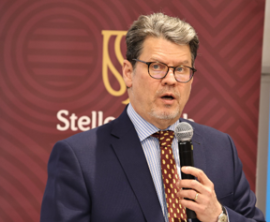
Deputy Minister of Justice and Constitutional Development Andries Nel has posited that corruption deepens inequality by exploiting existing gender power structures and disproportionately affects vulnerable groups, particularly women.
Nel delivered an address at the Stellenbosch University’s Symposium on Gender Inequality and Anti-Corruption, hosted by the university on Wednesday.
The symposium took place as South Africa commemorates the 70th anniversary of the historic 1956 march of 20 000 women to the Union Buildings, who stood up against apartheid pass laws.
“Corruption is not gender neutral because corruption does not take place in a socially neutral environment. It takes place within existing structures of economic, political and social power. Where those structures are characterised by significant gender inequality, corruption may reproduce or deepen that inequality.
“Conversely, unequal access to resources, institutions and decision-making can create forms of dependence and vulnerability that facilitate corruption. The relationship is therefore more complex than asking whether women suffer more from corruption than men,” the Deputy Minister said.
He noted that corruption redirects resources from public purposes to private interests, and a gender responsive analysis must ask who ultimately bears the costs when public services deteriorate.
“If access to a public service becomes dependent upon a bribe, political connection, personal relationship or some other improper consideration, a formally equal system may produce highly unequal outcomes. Those with resources may pay. Those with connections may circumvent the problem. Those without either may simply be excluded.
“Corruption must therefore be understood not only as a problem of legality or administrative efficiency, but also as a problem of substantive equality,” Nel stated.
From diagnosis to implementation
Nel noted that the Zondo Commission is a clear demonstration of the “systemic character corruption can assume”, adding that reforms borne from the report of that commission have recovered some R11 billion in stolen public funds.
On the ongoing Madlanga Commission, the Deputy Minister warned against prejudging matters, but added that “government cannot be indifferent to what is emerging”.
“Evidence before the Madlanga Commission has raised serious questions about aspects of IDAC’s [Investigating Directorate Against Corruption] own functioning and the exercise of its investigative mandate.
“These concerns have not been ignored by Government or by the leadership of the National Prosecuting Authority,” Nel stated.
The Deputy Minister described both commissions as part of an “evolving process of institutional learning”.
“The Zondo Commission required us to confront the consequences of institutional capture. The Madlanga Commission requires us to examine more closely the integrity of the institutions through which the State investigates, prosecutes and combats criminality and corruption.
“Both remind us that institutional reform cannot be a once-off event following a commission of inquiry.
“It must be a continuous process of building capacity, testing institutional arrangements against experience, identifying weaknesses and correcting them. A strong institution is not merely one with extensive powers. It is one capable of exercising those powers effectively, lawfully, professionally and accountably,” he noted.
Justice and Constitutional Development Minister Mmamoloko Kubayi announced a reset of IDAC, including a host of remedial activities to be carried out.
Since the revelations at the commission, IDAC Head Advocate Andrea Johnson has resigned from her position.
“Government established IDAC because South Africa needs effective specialised capacity to investigate serious corruption. That objective remains valid. The credibility of an anti-corruption institution depends not only upon the importance of its mandate; it also depends upon how that mandate is exercised.
“We must, therefore, be capable of doing two things simultaneously: strengthening the institutional capacity required to combat corruption, while insisting upon accountability where questions arise concerning the exercise of that capacity,” Nel insisted.
He called on all sectors gathered at the symposium and beyond to work with government to realise the constitutional ideal gender equality and accountability.
“Thirty years after the adoption of our Constitution, substantive equality and accountable government remain mutually reinforcing constitutional imperatives.
“Government has a responsibility to lead this work. However, building institutions that are more equal, accountable and resistant to corruption requires the active participation of all the sectors represented here,” Nel concluded. – SAnews.gov.za


