


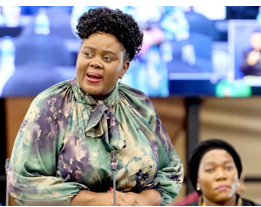
Minister of Justice and Constitutional Development, Mmamoloko Kubayi, has described the Constitution as a vital framework for the sustenance of democracy.
The Minister delivered a statement in the National Assembly on Tuesday on the occasion of the 30th anniversary of the Constitution of the Republic of South Africa.
Citing the words of former President Tata Nelson Mandela on the day the Constitution was adopted with a call for the improvement of lives, Kubayi called for lawmakers and public office bearers to reflect on the work needed to build a better life for all.
“It is time for all of us to reflect on this 30 years of our Constitution and recommit to ‘improve the quality of life of the people’ and recognise that “there is nothing else that can justify the existence of government but to redress the centuries of unspeakable privations, by striving to eliminate poverty, illiteracy, homelessness and disease.
“We celebrate the 30 years of the Constitution not because it is perfect but it is a vital framework for the sustenance of our democracy, progressive realisation of human rights, and accountability,” Kubayi said.
The Constitution was adopted 30 years ago, following collective negotiations with a number of politicians, legal scholars, intellectual architects and negotiators, and mass public participation.
“On 8 May 1996, elected representatives of the people of South Africa gathered in Parliament to celebrate the victory of the many years of struggle for freedom and democracy. Two years after our democratic elections, it was on this occasion that the Constitution, that is now part of who we are as South Africans, was adopted as the supreme law of the land, binding the executive, the legislature and the judiciary alike.
“The adoption of the constitution marked a significant and irreversible moment in our people’s march towards a united, non-racial, non-sexist and democratic South Africa.
“Our constitution did not only codify the norms and procedures of our democracy, but it also gave an expression to the aspirations of the majority of South Africans, thus becoming an integral part of who we are as South Africans,” Kubayi said.
She noted that the diversity of parties currently represented in Parliament is a testament of the “enduring legacy of what the Constitution has made possible in the ever-evolving political landscape of our country”.
Some 18 parties occupy the 400 seats that are available in the National Assembly.
“The parties represented here today were freely elected in open, free and fair elections representing the will of the people, giving life to the expression, 'The people shall govern', which is one of the cardinal pillars of our Constitution and democracy,” she told the assembly.
Depths of despair
Kubayi highlighted that the period before the adoption of the democratic Constitution was one where South Africa was at the depth of apartheid and preceding that, colonialisation.
She described pre-democracy South Africa as a place of “race-based dehumanisation and systematic dispossession and exclusion of the majority from political and economic participation”.
“Broadly speaking, our Constitution was drafted to achieve peace, unity and stability after many years of painful and violent struggle and secondly, to lay a foundation for a transformation of the South African society, so as to ‘Heal the divisions of the past and establish a society based on democratic values, social justice and fundamental human rights’.
“The drafters of the Constitution sought to negate the many years of racial segregation and institutionalised racial hierarchy.
“An honest assessment can only be done by looking at the provisions or elements of the Constitution and the concrete realities of the South African society. Except for sporadic and infrequent ill-informed discontent with our constitutional democracy, the Constitution has, in large measure, achieved the goal of creating a stable, peaceful and united country,” the minister stated.
Reflecting on the preamble of the Constitution, Kubayi highlighted that South Africans – despite the depravity of apartheid and colonisation – chose to say: “South Africa belongs to all who live in it - black and white”.
“South Africans refused to let the painful past get in the way of the creation of a future in which all South Africans, black and white, could live together, and build an equitable and prosperous country.
“Our judiciary has been consolidated into a unitary hierarchical structure that has asserted its independence with decisiveness and stood the test of time as a protector and defender of people’s rights.
“It is the transformation of [South Africa in all its dimensions], all of which can only be realised progressively... It is also precisely on the transformation project that our Constitution reveals its brilliance and foresight,” Kubayi said. – SAnews.gov.za


