


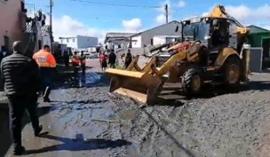
The City of Cape Town’s Urban Mobility Directorate, in collaboration with Disaster Risk Management and various service departments, is working around the clock to respond to the impact of heavy rainfall that swept across the metro over the weekend.
According to the city, approximately 480 flooding-related complaints were recorded between Friday and early Monday morning.
The City’s Mayoral Committee Member for Urban Mobility, Rob Quintas, said while response teams are currently on the ground, it is still too early to provide verified figures on the total number of incidents or the full extent of the damage.
He added that confirmed assessments will be communicated once completed and verified.
Widespread localised flooding was reported across both formal and informal residential areas following sustained downpours. Affected communities include Parkwood, Gugulethu, Khayelitsha, Delft, Ndabeni, Mitchells Plain, Southfield, Nyanga, Philippi, Elsies River, Kraaifontein and parts of Dunoon, among others.
Quintas said mop-up operations are underway in several areas, including Parkwood and Dunoon, where water has largely subsided.
However, he noted that illegal structures built over bulk stormwater and sewerage infrastructure continue to hamper maintenance efforts, as the teams cannot physically access the system to clear them.
“We saw mattresses and wheelie bins pulled from our stormwater system, among other wildly inappropriate objects and materials. Obviously, this can create massive blockages. This notwithstanding, our teams are deployed to areas where flooding is reported, and this is happening throughout all eight districts across the metro,” Quintas said.
He explained that heavy rainfall places pressure on the stormwater system, often resulting in water backing up onto roads, which then act as water conduits.
Low-lying areas, including areas below steep mountainous terrain, near canals and water bodies, are particularly vulnerable to localised flooding whilst rainfall remains heavy.
Quintas emphasised that stormwater infrastructure is designed to drain rainwater away over a period of time, and not to remove water instantly during heavy downpours.
“Localised flooding is expected while rain is falling. It is only considered a fault or a system failure if the water does not drain away after the rain has subsided.
“Residents in low-lying areas or those situated near water bodies are naturally more susceptible to localised flooding during intense weather events, [while] illegal buildings are also at risk, especially if they are erected in detention ponds,” Quintas said.
The City of Cape Town has since activated a multi-departmental emergency response and has assigned an additional budget for proactive stormwater management.
While the funding is specifically intended to mitigate the impact of heavy weather, the city noted that it cannot fully prevent flooding during extreme conditions.
Current interventions include clearing blocked stormwater drains and managing flooded roads, providing sand and milling for flood mitigation, and providing emergency assistance to residents in informal settlements with emergency materials like plastic sheeting.
The Disaster Operations Centre is prioritising the most vulnerable and high-risk areas.
Blocked stormwater and post-rain flooding can be reported via the city’s call centre on 0860 103 089.
Illegal dumping can also be reported on 0860 103 089 or email solidwaste.bylaw@capetown.gov.za.
Water and sewer-related issues can be reported via WhatsApp on 060 018 1505, SMS 31373, or email water@capetown.gov.za.
Electricity faults can be logged via WhatsApp on 060 018 1505 or SMS 31220.
Life-threatening emergencies should be reported to the Public Emergency Communication Centre on 021 480 7700. – SAnews.gov.za


