


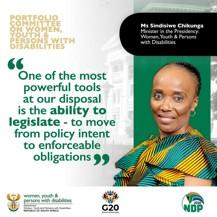
Minister in the Presidency for Women, Youth and Persons with Disabilities, Sindisiwe Chikunga, has laid out a firm and focused roadmap for the department, telling Parliament that the Strategic Plan and Annual Performance Plan being tabled is not “a wishlist” but a policy-driven programme aimed at driving institutional change.
Presenting the department's five-year Strategic Plan to the Portfolio Committee on Women, Youth and Persons with Disabilities, Chikunga emphasised that the plan is guided by constitutional responsibility and not rhetoric.
“We are not presenting a wishlist. We are presenting a focused, policy-driven programme of work. And we welcome your oversight, because it helps sharpen our ability to deliver,” she said.
The Minister stressed that the plan was crafted around three core strategic areas, including strengthening the fight against gender-based violence and femicide, responding more directly to youth unemployment and exclusion, and building a truly inclusive state for persons with disabilities.
“This five-year Strategic Plan is not just an internal planning document. It is our contract with the people of South Africa, a commitment to act with focus, discipline, and integrity in advancing their constitutional rights.
“We’ve taken time to reflect honestly on where we are. There are areas where progress has been made, and others where we are simply not moving fast enough. This plan is our attempt to be more deliberate — to do fewer things, better — and to ensure that what we prioritise has the full weight of policy, legislation, and institutional backing,” Chikunga told the Portfolio Committee.
Scaling up, accelerating delivery
On Gender-Base Violence and Femicide (GBVF), the Minister said the department is moving from “crisis response to institutional permanence,” with efforts underway to finalise the appointment of members to the National Council on GBVF.
Once established, the Council will serve as a key anchor in implementing the National Strategic Plan (NSP) on GBVF.
“In the interim, the department is strengthening the Technical Task Team, aligning sector departments behind the NSP priorities, and expanding provincial implementation support — with a specific focus on prevention, justice, psychosocial services, and the economic empowerment of survivors,” Chikunga said.
On youth development, she highlighted the revitalisation of the National Youth Machinery and the alignment of National Youth Development Agency (NYDA) support with initiatives such as the Presidential Youth Employment Intervention and the National Pathway Management Network.
Regarding disability rights, the department is enhancing the Disability Rights Machinery, rolling out infrastructure audits to promote universal design, and working with municipalities to improve accessibility.
“We know these challenges won’t be solved by one department. But we also know that if we don’t lead decisively on these issues, they will remain peripheral in the machinery of the state,” she added.
Advancing legislative agenda
Chikunga revealed that the department will push forward with four key Bills during the current Medium-Term Strategic Framework (MTSF) period:
- The National Council on Gender-Based Violence and Femicide Act — Parliament is finalising Council appointments, while the department works with Treasury and DPSA to operationalise the Council by 1 April 2026.
- The Women Empowerment and Gender Equality (WEGE) Bill — To be submitted to Cabinet this term, aimed at improving compliance with gender equality frameworks.
- The Promotion and Protection of the Rights of Persons with Disabilities Bill — In final drafting stages and aligned to the UN Convention on the Rights of Persons with Disabilities.
- The South African Youth Development Bill — Still being refined to streamline youth development coordination across the state.
“One of the most powerful tools at our disposal is the ability to legislate to move from policy intent to enforceable obligation. The test of any legislative agenda is not how many laws we pass but how well we implement them,” she said.
Building institutional discipline
Chikunga underscored the need for strengthened coordination and evidence-based delivery, with a plan to embed gender, youth, and disability imperatives in planning and budgeting frameworks across departments.
“We’ve spoken about focus, impact, and accountability. But none of that is possible without strong coordination systems. If implementation falters, it is often because coordination is weak and we are determined to fix that,” the Minister said.
She outlined ongoing work with Stats SA, Department of Planning, Monitoring and Evaluation (DPME), and other sector partners to strengthen Monitoring, Evaluation and Learning (MEL) systems, track disaggregated data, and ensure community-level feedback informs decision-making.
“Our aim is to move from episodic coordination to institutional discipline. From fragmented responses to coherent delivery. Because ultimately, our success will not be judged by what we announce but by what we achieve,” she added.
Chikunga also acknowledged the gravity of the issues at hand, including youth unemployment, violence against women, and systemic exclusion of persons with disabilities.
“We are not starting from zero. We are building on foundations — some strong, some uneven — and we intend to accelerate what works, correct what doesn’t, and ensure that our programmes are matched by institutional capability.
“We do not take this space for granted. It is a moment of reflection, of accountability, and of alignment between the work we do as a department and the constitutional responsibilities that we collectively carry,” she said. – SAnews.gov.za


