

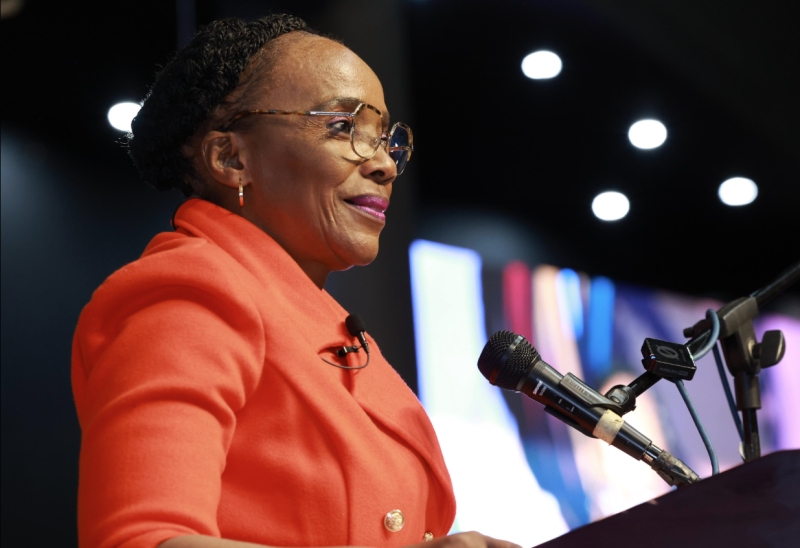
Minister in the Presidency for Women, Youth and Persons with Disabilities Sindisiwe Chikunga has called on government, business, academia and civil society to strengthen partnerships to remove barriers preventing persons with disabilities from participating fully in society.
Chikunga made the call on Friday during the launch of 2026 Disability Rights Awareness Month (DRAM) 2026 which will be observed from 3 November to 3 December.
The launch kicked off with a disability rights awareness walk from Church Square to the Union Buildings in Pretoria.
This year’s campaign is held under the theme: “Creating Multi-Sectoral Partnerships for a Disability-Inclusive Society” and seeks to promote coordinated action to advance the rights, dignity, equality and inclusion of persons with disabilities.
“Government effort on its own cannot guarantee a disability-inclusive society.
“We are leveraging DRAM 2026 to call for a collective effort towards removal of the barriers that continue to deny persons with disabilities equal opportunities, dignity and full participation in society,” Chikunga said.
She said the inclusion of persons with disabilities is a shared responsibility that requires all sectors of society to work together through purposeful partnerships that were coordinated, adequately resourced, measurable and accountable.
Chikunga also reaffirmed the importance of the principle of “Nothing about us, without us”, emphasising that persons with disabilities must be meaningfully involved in decisions affecting their lives.
“It is through your partnerships that persons with disabilities are not merely consulted but meaningfully involved in all decisions that affect both their lives and prospects for a better life,” she said.
The Minister described DRAM as an opportunity to celebrate the contributions of persons with disabilities across education, science, business, sport, the arts, public leadership and community development, while confronting the barriers that limit their participation.
She added that the campaign recognises disability as part of the human experience and promotes a society that embraced diversity, equality and shared prosperity.
Progress in advancing disability rights
Chikunga outlined several initiatives undertaken by the Department of Women, Youth and Persons with Disabilities to advance disability inclusion.
These include a study into the impact of climate-related emergencies, such as floods and extreme heat, on persons with disabilities.
Following the presentation of the study’s findings to Cabinet, a decision was taken to integrate them into municipal disaster management master plans.
The department is also working with the South African Local Government Association (SALGA) to address gaps in data on the geographical locations of persons with disabilities, which make it difficult to provide timely assistance during climate-related disasters.
In education, the department has been analysing gaps in basic education policies that undermine inclusive education.
The findings of that analysis are expected to inform the ongoing review of these policies.
On employment equity, Chikunga said a Department of Public Service and Administration circular had directed government towards a 7% employment target for persons with disabilities.
“This year, as we speak, employment equity is sitting at 5%, up from 4%. While this is progress, more still needs to be done,” she said.
She called on organisations of persons with disabilities to help identify eligible candidates and urged partners to consolidate associations of businesses owned and run by persons with disabilities to enable them to benefit from opportunities presented by the Public Procurement Act.
The department is also working on a Rights of Persons with Disabilities Bill, which Chikunga said is expected to be submitted to Parliament by the beginning of 2027.
In addition, work is underway to establish a Disability Nerve Centre of Excellence as part of the G20 Disability Inclusion Legacy Projects, with seed funding secured from the All-China Women’s Federation.
The country has also submitted its report under the United Nations Convention on the Rights of Persons with Disabilities (CRPD).
Women and girls with disabilities remain vulnerable
Despite the progress made, Chikunga highlighted the persistent discrimination and exclusion experienced by persons with disabilities, particularly women and girls.
As South Africa commemorates the 70th anniversary of the 1956 Women’s March this year, the Minister called for greater attention to the lived realities of women and girls with disabilities, especially amid the country’s ongoing crisis of gender-based violence and femicide (GBVF).
She highlighted that women with disabilities experience violence at rates estimated to be twice as high as those without disabilities.
“The struggle for gender equality cannot be complete while women and girls with disabilities continue to face discrimination and exclusion in education, employment, healthcare, financial services, public leadership and access to justice,” she said.
Chikunga said DRAM should place women and girls with disabilities at the centre of the national development agenda, not only as beneficiaries of empowerment programmes but also as leaders, decisionmakers, entrepreneurs, professionals and activists.
She called for stronger community-level partnerships to protect the safety and dignity of persons with disabilities and ensure that they could participate fully in everyday life.
Four priorities for disability inclusion
To translate the campaign's theme into practical action, Chikunga identified four areas requiring stronger multi-sectoral partnerships.
These include:
- Ensuring that persons with disabilities participate meaningfully in planning, decision-making and implementation
- Expanding access to education, employment, enterprise development and economic ownership
- Harnessing science and emerging technologies to promote independent living
- Strengthening community partnerships to protect the dignity, safety and wellbeing of persons with disabilities
She said accessibility should be incorporated from the outset when designing public transport systems, housing developments, roads, schools and public facilities.
The Minister also called for collaboration between universities, technical and vocational education and training (TVET) colleges and industry to expand access to accessible education, occupational training, workplace experience and employment opportunities.
Financial institutions, development agencies and businesses are also urged to improve access to finance, public procurement, supply chains and markets for entrepreneurs with disabilities.
On technology, Chikunga said innovations in artificial intelligence, communication devices, mobility technologies and digital learning platforms could improve access to education, employment, healthcare and public services.
However, she emphasised that persons with disabilities must be involved in developing technologies rather than having solutions adapted for them only after they had been created.
“These four areas remind us that multi-sectoral partnerships must be judged not by the number of agreements signed or meetings convened, but by the improvements they bring to the lives of persons with disabilities,” she said.
Disability Rights Awareness Month programme
Although officially launched on Friday, the main programme for Disability Rights Awareness Month will run from 3 November to 3 December 2026, culminating in the commemoration of the International Day of Persons with Disabilities.
The programme will focus on four weekly sub-themes.
The first week will focus on investing in growth strategies that promote disability-inclusive job creation, while the second will amplify the voices of youth with disabilities and encourage self-advocacy.
The third week will focus on unlocking digital opportunities for all through technology, while the fourth will coincide with the 16 Days of Activism against GBVF, with an emphasis on disability-inclusive approaches to women's empowerment and gender equality.
The final week will also focus on strengthening partnerships to prevent violence against women and girls with disabilities, improve protection and expand access to justice and support services.
The department has called on all spheres of government, the private sector, civil society and organisations of persons with disabilities to support and participate in activities aligned with these priorities.
The DRAM campaign is informed by the priorities of government’s Medium-Term Development Plan and the White Paper on the Rights of Persons with Disabilities which focuses on inclusive economic growth, job creation, poverty reduction and building a capable, ethical and developmental state.
Chikunga officially launched the month by calling for renewed commitment and measurable action to ensure that disability inclusion translated into tangible improvements in people's lives.
“Together, let us move beyond declarations of intent and make disability inclusion a lived reality for all,” she said. – SAnews.gov.za


