


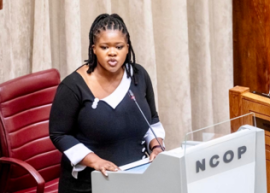
Deputy Minister in the Presidency, Nonceba Mhlauli, has called for renewed global commitment to peace and decisive action to enforce existing protections for women.
Speaking at the National Council of Provinces (NCOP) debate in commemoration of International Women’s Day, Mhlauli warned that without stability and political will, gender equality will remain out of reach.
"We must be unequivocal in our call for peace. Peace is not an abstract diplomatic ideal. It is the foundation upon which women are able to live safely, to participate economically, to raise families without fear, and to contribute meaningfully to society.
"Where there is no peace, there can be no justice for women. Where there is no stability, empowerment becomes an empty promise,” Mhlauli said on Wednesday.
The debate was held under the theme: “Recentering Social Justice and Human Rights for Women and Girls”.
While acknowledging the policy and legal frameworks that exist globally, which are designed to advance gender equality, Mhlauli said their impact is weakened by inconsistent enforcement and insufficient political commitment.
“Yes, policy and legal frameworks exist. They are in place through the Convention on the Elimination of All Forms of Discrimination against Women (CEDAW), adopted in 1979 by the UN General Assembly, the Beijing Platform for Action, the AU Agenda 2063, and our own South African Constitution.
"What has wavered is not the law but the political will to enforce it, to fund it, and to live by it,” the Deputy Minister said.
According to Mhlauli, the real measure of progress lies not in policy declarations but in the everyday realities experienced by women and girls.
“The real test is not how well we can recite these conventions but whether a woman can walk home safely. Whether a survivor can access justice without being retraumatised. Whether a girl child can learn without fear. Whether a woman-owned enterprise can access markets, finance and procurement without being blocked by old networks and gatekeeping.”
As the global community marks Beijing+30, commemorating three decades since the adoption of the Beijing Platform for Action, Mhlauli said the moment required honest reflection.
She acknowledged that important gains have been achieved globally, including reductions in maternal mortality, improved enrolment of girls in schools and increased representation of women in legislatures.
But, she said the progress is fragile, uneven, and in many parts of the world, it is reversing.
Mhlauli highlighted the devastating toll conflicts are taking on women and girls in regions such as Sudan, the Democratic Republic of Congo, Palestine and parts of the Middle East.
“In these theatres of war and political upheaval, it is women and girls who bear the heaviest burden. They are displaced from their homes, stripped of access to education and healthcare, subjected to violence, and denied even the most basic forms of dignity.
“Conflict does not only destroy infrastructure. It erodes the social fabric that protects women. It turns their bodies into battlegrounds and their rights into collateral damage, Mhlauli said.
South Africa, she said, maintains a principled position in support of peaceful resolution of conflicts, dialogue over destruction, and the protection of civilians, particularly women and children.
“We affirm that the empowerment of women must extend to every sphere of life political, social, and economic. Women must not only survive conflict; they must be included in peacebuilding, reconstruction, and governance processes. Sustainable peace is only possible when women are present at negotiation tables and in leadership structures shaping the future,” she said. – SAnews.gov.za


