


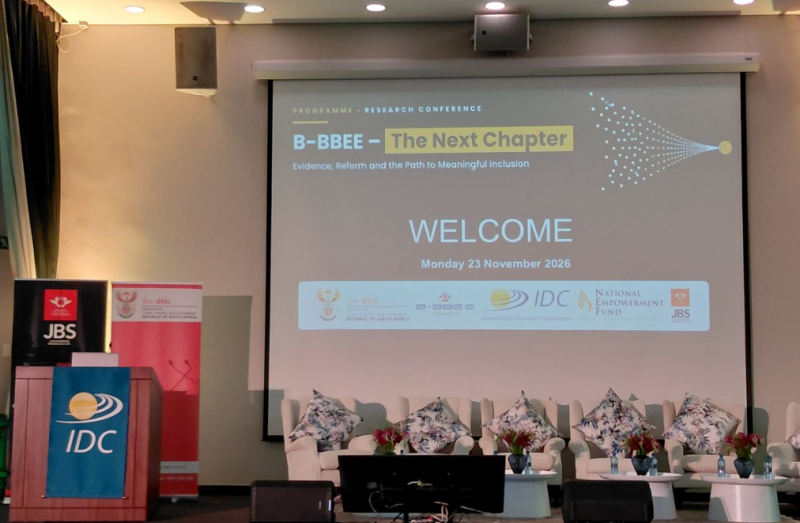
Broad-Based Black Economic Empowerment (B-BBEE) must benefit all South Africans, with government’s approach to transformation informed by reliable data and evidence to ensure meaningful and inclusive economic participation.
This was emphasised by Acting Deputy Director-General of Transformation and Competition at the Department of Trade, Industry and Competition (the dtic), Dr Susan Mangole, during her closing remarks at the Practice and Policy Conference on Broad-Based Black Economic Empowerment (B-BBEE), held in Johannesburg from 23 to 24 November 2026.
The conference was held under the theme: "The Next Chapter: Evidence, Reform and the Path to Meaningful Inclusion."
Referring to observations made by former Statistician-General, Dr Pali Lehohla, Mangole said government’s approach to B-BBEE must be grounded in reliable data to ensure that the policy delivers tangible benefits across the country.
Mangole also reiterated the commitment made by Minister Parks Tau, that the department will work with Statistics South Africa and other key stakeholders to shape the future framework for B-BBEE.
She emphasised that the policy development process must include the voices and experiences of South Africans, adding that the department and its stakeholders would continue taking the conversation across the country to gather public input and evidence on what citizens want from the policy.
“Let us work together and build a South Africa that is economically inclusive,” added Mangole.
Mangole further indicated that, as consultations continue, a policy brief will be submitted to the dtic and the Presidency within 30 days to serve as a basis for further engagements.
Meanwhile, Lehohla challenged delegates to consider whether sufficient attention was being given to stimulating economic participation and creating meaningful opportunities for people to contribute to the economy.
He cautioned that unless the fundamental challenges facing the economy were addressed, the country would continue reproducing existing inequalities.
Lehohla highlighted inequalities within the education system, particularly the number of learners who are lost along the schooling journey, as an area requiring urgent attention.
He argued that South Africa’s economic policy is failing to adequately address structural inequality, weak local production, job losses and declining trust in democracy.
He also criticised empowerment and compliance-focused approaches, arguing that they were insufficient to achieve meaningful transformation. Instead, he called for evidence-based and geographically targeted investment to strengthen local supply chains, create jobs and ensure that more economic value remains within communities.
Among his proposals was targeted support for school feeding programmes and agriculture as a way of strengthening local economic participation and stimulating growth.
“If we had a stronger agricultural sector capable of supplying nutritious food to children at schools, the economic and social benefits would be significant. The multiplier effect of participating in agriculture could be far greater than simply allowing traders to benefit from the value chain,” added Lehohla.
He further stressed the importance of encouraging communities to participate in agriculture and consume the food they produce, rather than exposing children to poor-quality food and its associated consequences.
“Leadership and economic power remain concentrated in particular sectors, especially mining and financial services. The problem with B-BBEE is that, for as long as economic power remains concentrated, meaningful transformation will remain limited,” said Lehohla.
Adding to the discussions, the Competition Commission’s James Hodge shared key findings from the Concentration Tracker Report, published in May 2026.
The Commission is an agency of the dtic.
Hodge highlighted the important role played by micro, small and medium enterprises (MSMEs) in job creation, noting that they account for 44% of employment and are twice as employment intensive as large firms.
However, he acknowledged that significant challenges remain in expanding their participation and enabling them to grow within the economy.
To address these constraints, the report recommended that government policy and competition law place greater emphasis on scaling successful market entrants, identifying this as the single largest bottleneck to MSME growth.
This would require increased funding and stronger enforcement measures to support medium-sized and larger challengers that have demonstrated their capabilities.
The conference was convened by the Johannesburg Business School (JBS) within the University of Johannesburg and co-hosted by the Industrial Development Corporation (IDC), the National Empowerment Fund, the dtic, the B-BBEE Commission and the Policy and Research Services Unit in The Presidency.
The event was supported by the Deutsche Gesellschaft für Internationale Zusammenarbeit (GIZ) through its South Africa country programme. – SAnews.gov.za


