


Preliminary observations of the Promotion Mission undertaken by the African Union’s (AU) African Commission on Human and Peoples' Rights (ACHPR) has found that South Africa has a comprehensive framework for the protection of human rights.
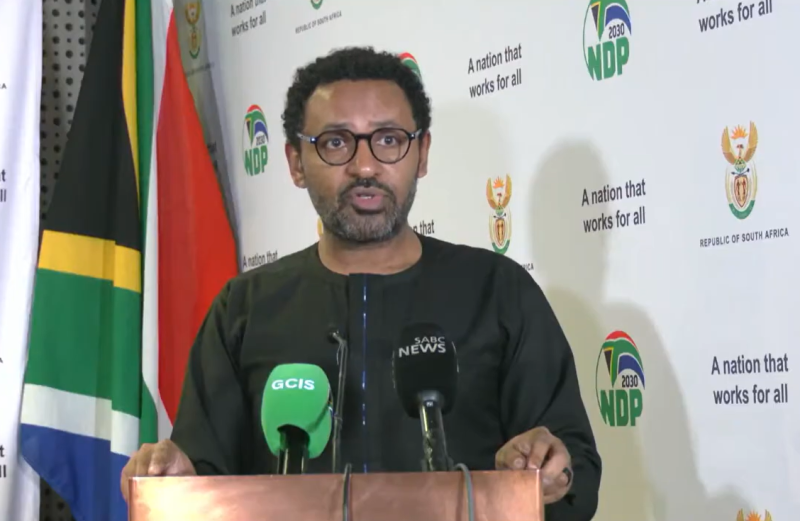
This was revealed by ACHPR mission delegate and Commissioner Rapporteur on the human rights situation in the Republic of South Africa and Chairperson of the Working Group on Extractive Industries, Environment and Human Rights Violations in Africa, Dr Solomon Ayele Dersso, during a media briefing held on Friday.
The delegation arrived in the country on Sunday, 27 September 2026 and ended the Promotion Mission on Friday, 2 October 2026.
“It is the finding that South Africa has a very robust and comprehensive framework for the protection of human and people’s rights in South Africa. [This is] not only the rights of South African citizens but also the rights of non-nationals are legally provided with protection (sic).
“It is with deep appreciation that we recognise, for example, the fact that South Africa has a robust protection regime for refugees and asylum seekers who come to South Africa in search of protection from persecution that they are running from.
“This is something that sets an example for others on the continent. Particularly in terms of the fact that South Africa doesn’t actually confine asylum seekers and refugees to a refugee camp somewhere outside of society. South Africa allows [them] to live in and as part of society. This is something we acknowledge with appreciation,” Dersso said at the briefing held in Pretoria.
Furthermore, the mission acknowledged South Africa’s “very robust” institutions.
“The independence of the judiciary, whose jurisprudence has enhanced the protection that is availed through the Constitution and other legislation that gives effect to the rights and freedoms in the African Charter on Human and Peoples Rights, including the protection of refugees and asylum seekers [and] including as it relates to certain social benefits like social grants, for example.
“We recognise…Chapter 9 institutions that give richness to the democratic and Constitutional strength of South Africa. We consider the [Commission for ] Gender Commission, the Human Rights Commission, the Cultural, Religious and Linguistic Rights Commission as important aspects of the protection regime of South Africa.
“We also recognise the role the Public Protector plays in holding government officials accountable in terms of ethical standards, [and] abuse of power which directly affect the access of citizens to their rights including to the delivery of services,” he explained.
Dersso noted that the mission’s work was not only confined to South Africa’s treatment of refugees and asylum seekers.
“It also covered all the other areas of human rights. Whether that relates to indigenous peoples, the rights of women and girls, the rights of older persons, or human rights in the extractive industries or freedom of expression, access to information and rights in prison conditions.
“These are the wide range of rights. Of course, we have also covered economic, social and cultural rights which are critical for the majority of South Africans on account of the history of the country,” the Commissioner said.
Challenges
He added, however, that the mission observed “some issues” in South Africa, adding that the Commission appreciates the socio-economic context in which the challenges exist.
“These include the nearly 40% unemployment rate that affects so prominently the youth in particular. This creates social implications for social cohesion and also for the enjoyment of a life of dignity.
He also pointed to the poverty in the country.
“These conditions are a result of, in significant ways, the apartheid history of South Africa. This requires robust intervention from South Africa, including taking positive measures for removing the conditions that keep people from having access to equality, access to opportunities.
“Interventions need to be strengthened. These are not the kinds of things South Africa needs to relent on; it should actually persist in order to achieve equality and a better standard of living particularly for the historically marginalised population,” Dersso said.
He acknowledged that the country has “come a long way but [that] there is a long way yet to go”.
“Not just the incidents relating to foreign nationals but incidents…including gender-based violence and femicide. The incidents of crime and its impact on the lives, opportunities and economic conditions of people.
“These and recent incidents of mass killing highlight the gravity of what South Africans have to deal with in terms of their protection from violence.
“We…take note of the efforts that are being deployed. But…it is our appeal that there is a need for a more robust response to crime. Not just to individuals…but also to the system that makes crime possible,” the Commissioner said.
A full report of the mission’s observation is expected to be released soon. – SAnews.gov.za


