


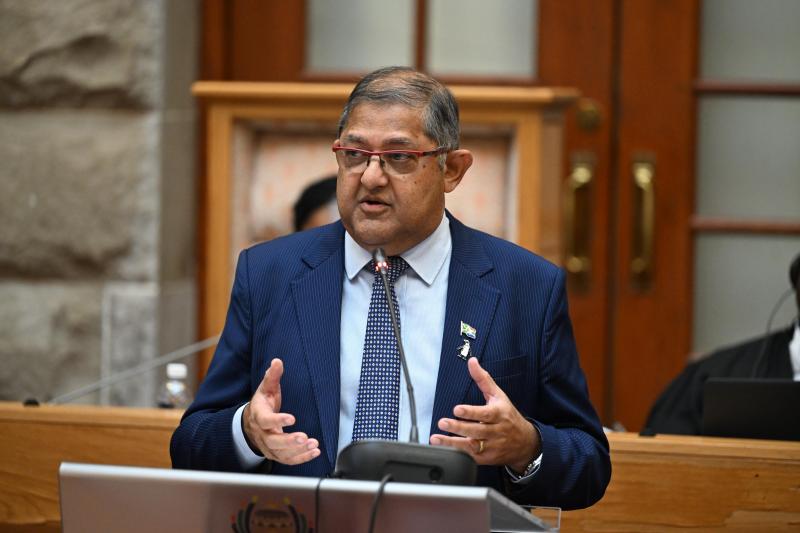
Deputy Minister of Forestry, Fisheries and the Environment Narend Singh has called for closer cooperation between government and the traditional medicine sector to cultivate medicinal plants and reduce pressure on species threatened by unsustainable wild harvesting.
The call comes as the South African National Biodiversity Institute (SANBI) estimates that 2 062 indigenous plant species are used in traditional medicine.
“That is about one in 10 of all the plant species in South Africa. Behind those plants stand more than 200,000 traditional health practitioners.
“Think about that for a moment. This is not a fringe practice. This is a health system. It is also under strain. Towns and cities want more of these plants than the wild can give.
“Harvesting has become harder, sometimes reckless. Drought and a changing climate are making bad years worse. Poverty pushes people to take what they can sell today. And some of the trade is simply illegal,” the Deputy Minister said.
Addressing the India–South Africa Traditional Medicines Symposium and Exhibition in Durban on Saturday, Singh said the 2024 Red List of endangered plants shows that 154 commonly used medicinal plant species — and their unique genomes — are at risk of extinction because of overuse.
“If the plant goes, the medicine goes with it. You cannot keep a tradition alive in a storeroom. If we want traditional medicine to have a future, the plants have to have a future too.
“We have to learn to grow what we use, put back what we have taken, and leave enough for the next pair of hands. We have to manage these genetic resources and their gene pools responsibly,” he said.
Singh said the responsibility to protect biodiversity also extends to the digital DNA sequence information derived from these plants.
“As advances in biodiversity science increasingly rely on nature's Digital Sequence Information (DSI), we must ensure that the benefits arising from the use of our biodiversity are shared fairly and equitably with all South Africans practitioners,” Singh said.
Against this backdrop, Singh urged the sector to accelerate the shift from wild harvesting to cultivation.
“SANBI is already in it with us. They keep the record: which plants and genetic resources are used, which ones are slipping, which populations are in trouble. They maintain the National Red List.
“They help us name a plant correctly, grow it, and put it back, whether that means protecting it where it already grows or keeping it safe in cultivation. None of that works if it is done over the heads of the people who know the plants.
“So, the institute is working with traditional health practitioners, traditional leaders, communities and the provincial conservation authorities,” the Deputy Minister said.
He said the goal was not simply to preserve rare species, but to ensure that rural healers could continue to access or grow the plants their patients need, while enabling households to earn an income without exhausting natural stocks.
“We are also trying to find the money to do this properly, not as a pilot that ends when the workshop ends. Under Component 2 of the Global Environment Facility (GEF-8) proposal, Securing Nature’s Contributions to People,” Singh said.
To turn this approach into practical action, Singh said SANBI had proposed a project focused on propagation, training and land restoration.
“Healers have already named 15 medicinal plants that are becoming hard to find in the wild. The proposal is to multiply those at scale. To hand mother stock and proper horticultural training to 1,800 traditional healers and community members, at least half of them women.
“To restore 1,800 hectares of tired communal land in Limpopo, North West and the Eastern Cape. And to map a network of places that matter culturally, not only scientifically, in three provinces,” the Deputy Minister said.
Singh urged the sector to expand nurseries and build on the work already undertaken by SANBI and traditional healers, including the identification of 15 scarce species, the provision of mother stock, training for 1 800 people and the restoration of communal land.
“Let us build value chains that do not cheat the community at the end of them. Let us write down what is at risk of dying with the elders, and let us do it with their consent, not around them.
“Let us make room for young people, and especially for women, who are already half the story and too often none of the credit,” he said. -SAnews.gov.za


