


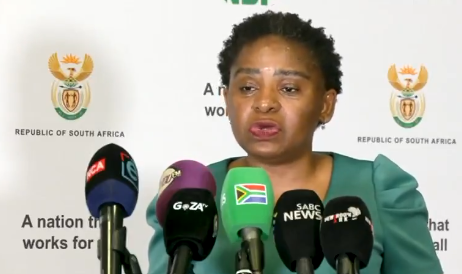
Minister in the Presidency Khumbudzo Ntshavheni has rejected claims that government has been reactive to misinformation surrounding irregular migration, saying authorities have been working on the issues as part of measures to strengthen South Africa's immigration system.
Ntshavheni was responding to questions at a briefing by the Inter-Ministerial Committee (IMC) on Migration in Pretoria on Thursday, amid widespread misinformation surrounding the Constitutional Court judgment on asylum applications -- which was handed down in July -- and the subsequent influx of people at Refugee Reception Offices.
The IMC said the Constitutional Court judgment, in the matter of Scalabrini Centre of Cape Town and Another v Minister of Home Affairs and Others, must not be interpreted as legalising unlawful migration or giving people an automatic right to remain in the country.
The Court declared certain provisions of the Refugees Act unconstitutional because they prevented some people from accessing the asylum system solely on procedural grounds. These included people who had entered South Africa irregularly, did not possess an asylum transit visa, or failed to report to a Refugee Reception Office within the prescribed period.
The Court found that such procedural barriers could result in people being excluded from the asylum process before their claims were properly assessed.
READ | ConCourt asylum ruling does not automatically grant refugee status – IMC
Ntshavheni said the spread of misinformation in this matter stems from a misunderstanding of directives, issued by the Department of Home Affairs to Refugee Reception Offices, as it pertains to implementing the Constitutional Court judgment.
She said government will review the directives to ensure there is no further confusion.
“[Another] allegation is that there are people who are using broadcasting platforms to spread misinformation,” she said, adding that complaints about broadcasters or presenters allegedly spreading misinformation could be lodged through the Broadcasting Complaints Commission of South Africa.
She also reminded the public that the public broadcaster is not a State institution and therefore operates independently of government.
Ntshavheni said an important part of the misinformation surrounding the asylum issue is the suggestion that the current situation results from a government decision.
“The first piece of misinformation is that this is a government decision. We must be clear; it is the Constitutional Court decision of the 7th of July 2026,” the Minister said.
She also stressed the constitutional separation of powers among the legislature, executive and judiciary.
Parliament, she explained, is responsible for making and amending legislation; the executive is responsible for the day-to-day running of government and policy direction, while the judiciary adjudicates matters before the courts.
She said the Constitutional Court is the apex court in the judiciary and that its decisions must be respected.
Ntshavheni said government, nevertheless, has a responsibility to protect the interests of South Africans, while complying with the Constitution and the country’s legal obligations.
She said the IMC has recognised the unintended consequences arising from the judgment and is obtaining legal advice on the options available to government.
“We have met and we continue to meet to process this issue so that we are guided by the law because, as the Chairperson [of the IMC, Minister Kubayi] has said in the statement, the Constitution of the country is supreme and therefore, we need to be guided,” the Ntshavheni said.
Economic hardship not grounds for refugee status
Ntshavheni also sought to draw a distinction between people fleeing persecution or war and those who enter South Africa for economic reasons. She noted that South African law and international refugee conventions do not recognise economic hardship as a basis for refugee status.
“There is no economic refugee that is provided for in our Constitution, our laws and in the international conventions of the United Nations,” the Minister said.
Ntshavheni said people who qualify for refugee protection are generally those fleeing persecution or war, and referred to the principle of seeking protection in the first country of safety.
She cited Zimbabwe, Mozambique, Eswatini, Namibia, Lesotho and Botswana in her discussion of the principle, and said government will have to consider the implications of this, within South Africa’s legal framework and international obligations.
Government moves against fraudulent refugee status
Ntshavheni said government is also addressing allegations of fraudulent asylum and refugee statuses.
She confirmed that work arising from the Special Investigating Unit (SIU) investigations has already resulted in Home Affairs beginning the process of revoking statuses granted fraudulently.
The Minister said the revocations are being done in batches as cases are processed and that Home Affairs will provide figures on the number of statuses revoked.
She reiterated that the IMC will support extending the SIU’s existing mandate to cover the asylum seeker and refugee system.
Ntshavheni also warned people against deliberately abusing the asylum system.
We are also sending a clear message: if you are going to try to defraud the system and apply for refugee status as an asylum seeker in the country and you know you do not qualify, the law will deal with you decisively,” she said.
Ntshavheni pushed back against suggestions that government had spent the three months since the Constitutional Court judgment not taking action. She said government had approached the Gauteng Judge President regarding contradictory High Court judgments and had made submissions ahead of court proceedings later this month. She said the Judge President has instituted a panel to deal with the matter.
“We have been doing work. There is a full submission that was done,” she said.
Ntshavheni said the State is also considering the broader legal and policy implications of migration challenges.
Constitution
Ntshavheni further rejected the notion that government should simply move to amend the Constitution whenever there are difficult policy or legal consequences.
She said the first step is to determine whether existing legislation and regulations could address the problem within the current constitutional framework.
The Minister said any amendment should be a last resort, and that South Africans themselves have a role to play in raising concerns about legislation and constitutional provisions through Parliament.
Ntshavheni said citizens could also approach Parliament through mechanisms such as the Petitions Committee.
“You must play your part and play your part in a constructive manner within the provisions of the laws and the Constitution of this Republic,” she said.
The Minister said government will continue to act within the Constitution, while pursuing measures to protect South Africa's national interests, territorial integrity, safety and security. – SAnews.gov.za


