


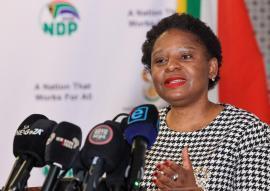
South Africa’s Broad-Based Black Economic Empowerment (BBBEE) policy remains an important tool to address the injustice of Apartheid, Minister in the Presidency Khumbudzo Ntshavheni said.
“Apartheid was declared a crime against humanity. It was also an economic crime. Families were forcibly removed from their land. Workers were barred by law from skilled jobs.
“Black children were given an education designed to keep them in servitude. In 1994, South Africans chose redress over retribution. B-BBEE is an instrument of that choice, and section 9(2) of the Constitution requires it. Redress is a constitutional obligation, not a bargaining chip. And it is working. Behind every figure is a South African whose life has changed,” she said.
Speaking to IOL, the Minister said 3.4 million black South Africans belong to a middle class their parents were barred from by law, with R400 billion a year in spending power.
According to the Broad -Based Black Economic Empowerment Amendment Act, BBBEE means the viable economic empowerment of all black people [including], in particular, women, workers, youth, people with disabilities and people living in rural areas, through diverse but integrated socio-economic strategies that include, but are not limited to, increasing the number of black people that manage, own and control enterprises and productive assets, among others.
Equity Equivalent Investment Programmes
She added that through the Youth Employment Service, created under the B-BBEE framework, some 240 000 young people have been given a full year of paid work, earning R15 billion in salaries.
More than half are young women. And through Equity Equivalent Investment Programmes [EEIP] alone, global companies have created more than 2 000 jobs, backed 87 black-owned businesses, almost half of them owned by black women, and trained more than 2 500 people.
In his newsletter to the nation in June last year, President Cyril Ramaphosa said the EEIP was created to accommodate multinationals whose global practices or policies prevent them from complying with the B-BBEE ownership element through the ‘traditional’ sale of equity or shares.
The programme allows multinationals to invest in socio-economic, skills and enterprise development in South Africa without selling equity in their local subsidiaries.
The Minister added that this progress has not come at the expense of white South Africans, who continue to prosper in our economy.
“It belongs to the whole nation,” she said, adding that for many, the promise of 1994 is not yet fulfilled.
This as 23.1 million black South Africans remain outside of the fruits of the economic prosperity. A typical black African worker earns R5 200 a month, and the typical white worker earns R25 000.
“To abandon redress now would be to tell these South Africans that their freedom ends at the ballot box.”
The Minister stressed that B-BBEE is not a precondition for investing in South Africa and that it applies where a company requires a licence from the state, such as in mining and ICT.
Multinationals whose policies, on the proof thereof, do not allow them to sell local equity can comply through EEIPs.
She added that South Africa is a founding member of the World Trade Organization and a non-aligned country.
“Non-discrimination is a principle we hold to. Every investor plays by the same rules in our country, wherever they come from,” she said.
Requirements and flexibility
On ownership requirements in the mining industry, these are not arbitrary.
Under the Mineral and Petroleum Resources Development Act, South Africa’s minerals are the common heritage of all South Africans, held by the State as custodian.
“Those who extract them must share the benefit with the people who own them. Multinationals that do not wish to sell equity have a clear alternative in EEIPs,” she added.
There is also flexibility across sectors of the economy, with each sector having a set of Sector Codes governed by a charter council that negotiates their flexibilities within agreed-upon frameworks applicable to that respective sector.
“Under the B-BBEE Codes, a multinational that cannot sell local equity, by virtue of their policies, can instead make an equivalent contribution to black-owned enterprises and suppliers, skills development and other national priorities through an EEIP. Cabinet has also supported a review of the framework to strengthen it for transformation and growth,” she explained.
Companies that comply with B-BBEE through Equity Equivalent Investment Programmes and investing in black-owned businesses and skills instead of selling equity include Dell, Microsoft and HP.
“Others continue to expand: Microsoft has announced a R5.4 billion investment in local cloud and AI [artificial intelligence] infrastructure, and the US International Development Finance Corporation has invested $50 million in the Phalaborwa rare earths project. Amazon Web Services is investing in cloud infrastructure over several years,” she explained.
Serving development
She added that South Africa determines its domestic policy on the basis of the best interests of citizens.
“Our energy, telecommunications and mining rules are made by South Africans, under our Constitution, to serve our development.”
This as the country provides fair market access for all partners.
Ntshavheni said while South Africa wants foreign capital, it wants it to build processing, beneficiation and manufacturing capacity on home soil.
“That is investment with development, not investment at the expense of development. Our minerals belong to the people of South Africa and must work in their interest. Investors who help build these value chains here are partners in that project, and we are actively seeking them.”
She explained that the Department of Trade, Industry and Competition (dtic) is already taking investors through what the policy provides, including its flexibilities, and engages companies on individual transactions.
“B-BBEE ensures that growth is shared, and that is what makes it sustainable,” she told IOL. -SAnews.gov.za


