


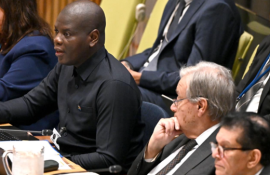
South Africa has called for renewed international action to translate the commitments of the Durban Declaration and Programme of Action into measurable progress, as the United Nations marks 25 years since the landmark framework against racism, racial discrimination, xenophobia and related intolerance was adopted.
International Relations and Cooperation Minister Ronald Lamola made the call on Monday during a high-level meeting of the 81st United Nations General Assembly (UNGA) commemorating the 25th anniversary of the adoption of the Durban Declaration and Programme of Action (DDPA).
The meeting, held at United Nations Headquarters in New York, was convened under the theme: “Mobilizing global public support for the full and effective implementation of the Durban Declaration and Programme of Action.”
The UN describes the DDPA as a global blueprint for combating racism, racial discrimination, xenophobia and related intolerance.
The anniversary provides an opportunity to assess progress since the 2001 World Conference against Racism, Racial Discrimination, Xenophobia and Related Intolerance in Durban and to renew political commitment to implementing its recommendations.
Reflecting on the significance of the 2001 conference, Lamola said the gathering in Durban, KwaZulu-Natal represented a defining moment in the global fight against racism and the legacies of historical injustice.
“Twenty-five years ago, the world converged on our shores in Durban, South Africa, for the World Conference against Racism, Racial Discrimination, Xenophobia and Related Intolerance,” he said.
He recalled that former President Thabo Mbeki had described the conference as heralding a new internationalism, marked by a determination to “unite in action to repair the gross damage that was caused in the past.”
Lamola said the conference produced a framework aimed at confronting the legacies of slavery, colonialism, apartheid and racial discrimination.
“The Durban Declaration and Programme of Action marked a pivotal moment in the international community’s commitment to build a world rooted in equality, dignity and justice,” he said.
He said the Durban process had recognised that combating racism required more than government action, with civil society, communities and individuals also having an important role to play.
Racism and xenophobia persist
Lamola said the global environment remains challenging 25 years after the adoption of the DDPA.
“Racism persists. Xenophobia and related intolerance are finding renewed expression, worsened by online hate messages,” he said.
He also warned that progress towards gender equality is under pressure, while measures aimed at redress and combating racism were increasingly facing resistance.
Lamola said contemporary racism against Africans and people of African descent remained embedded in institutions, systems and practices governing societies.
“This is why we must strengthen our collective efforts,” he said.
The UN has similarly noted that, 25 years after its adoption, racism and racial discrimination remain embedded across institutions and societies and can be amplified by emerging digital technologies and artificial intelligence.
Lamola linked the persistence of racism to broader challenges of inequality, insecurity and social polarisation.
“Inequality and insecurity provide fertile ground for resentment and polarisation,” he said.
He added that growing anti-migrant sentiment, particularly where migrants are blamed for socio-economic difficulties, made international cooperation on migration pressures increasingly important.
“The global hardening of attitudes towards migrants – who are often scapegoated for socio-economic hardship – is all the more reason for us to push for more cooperative ways of addressing migration pressures.”
Lamola stressed that states remain responsible for managing irregular migration while warning that failure to cooperate could create space for actors seeking to exploit racial and ethnic divisions.
“Failure to cooperate leaves the door wide open for actors whose conduct runs counter to the principles of equality, dignity and human solidarity that we stand for,” he said.
Calls for reparative justice
The Minister highlighted recent developments at the United Nations as evidence that international efforts to address historical injustice could advance.
“With Ghana’s leadership and the support of the African Union, this General Assembly recently adopted a Declaration of the ‘Trafficking of Enslaved Africans and the Racialized Chattel Enslavement of Africans as the Gravest Crime Against Humanity’,” he said.
Lamola said the declaration strengthened the case for reparative justice.
He also welcomed a General Assembly resolution addressing global cartographic representation, saying it would help correct longstanding distortions in the depiction of Africa.
“These advances remind us that past wrongs will not right themselves. Historical distortions do not correct themselves. And progress is always a product of struggle,” he said.
Call for action on historical injustices
Lamola called on states to address the continuing legacies of historical injustice through a range of measures, including formal apologies, truth-telling, reparations and the return of cultural artefacts.
He also welcomed progress towards a UN Declaration on the Human Rights of People of African Descent.
“We welcome progress towards a UN Declaration on the Human Rights of People of African Descent. This anniversary should mark a turning point in protecting human rights, reducing inequality and advancing inclusive development,” he said.
Lamola said the envisaged declaration should provide a framework for addressing past injustices and give practical effect to the Second International Decade for People of African Descent.
Strengthening national human rights institutions
South Africa also welcomed the political declaration marking the DDPA's 25th anniversary and called on countries to establish or strengthen independent national human rights institutions.
“These institutions should play a vital role in monitoring and evaluating the implementation of the commitments made in Durban,” he said.
Lamola said the anniversary should not become merely an occasion for reflection but should generate concrete and measurable action.
“The Declaration calls upon us to marshal political will at every level and to build momentum that cannot be turned back,” he said.
He said South Africa would continue taking steps nationally, regionally and internationally to combat racism, racial discrimination, xenophobia and related intolerance.
As the international community marked a quarter century since the Durban conference, Lamola said the work of building more equal societies remained unfinished.
“Twenty-five years ago, we recognised that Durban marked the beginning, not the end.
“The task of building a world free of racism, righting the wrongs of the past and restoring the human dignity of all is as much ours today as it was for the generation that converged in Durban a quarter century ago,” Lamola said.
The high-level meeting forms part of UNGA81's programme of high-level engagements and was held in accordance with General Assembly resolutions 80/193 and 80/299. – SAnews.gov.za


