


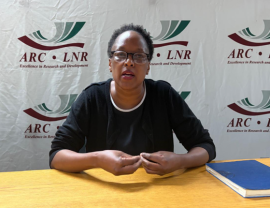
For Dr Faith Peta, the journey into science began with an unlikely source of inspiration: Brooke Logan, a character in The Bold and the Beautiful, an international television soap drama. More than 20 years later, Peta has helped develop South Africa’s locally produced Foot-and-Mouth Disease (FMD) vaccine – a journey she sees as a testament to life unfolding as it should.
Peta is a scientist and Chief Research Technician in the FMD Vaccine Production Programme at the Agricultural Research Council (ARC). The programme focuses on the development and manufacturing of specialised veterinary vaccines to address domestic outbreaks while improving the health of livestock.
The council is an entity of the National Department of Agriculture. South Africa ceased the production of the vaccine in 2005 due to ageing technology and infrastructure, which were non-compliant with the international Good Manufacturing Practice standard.
Hers is a story of determination, curiosity and an innate responsibility to leave the world in a better state than she found it.
“A human being,” she modestly answers the question of who she is, bursting into laughter before proceeding to list the different roles she plays, including sister, team leader and daughter.
FMD developments
As the team leader, she played an important role in the historic development of the country’s locally produced Foot-and-Mouth Disease (FMD) vaccine. On 6 February 2026, the ARC handed over the first batch of 12 900 locally produced FMD vaccine doses, which were subsequently distributed across the nine provinces.
In her role at the ARC-Onderstepoort Veterinary Research (ARC-OVR), she manages all technical activities related to vaccine production, including personnel and infrastructure.
“Because FMD is still problematic and we still don’t have, as the ARC, adequate capacity to satisfy the national demand, we have brought bigger equipment [to produce more vaccine doses]. They will be installed as of next month, and we are hoping that by next year we will be able to at least start meeting the demand of our country based on the control strategy that the government has set out,” she said in an interview with SAnews.
The ARC has committed to producing 20 000 doses per week, with plans to scale up to 200 000 doses per week in 2027.
She is a key member of the team designing a new vaccine manufacturing factory, having developed the user requirements and technical specifications for production equipment.
“We are busy buying bigger vaccine production vessels, 1000-litre systems, and we will install them in our existing facility as a stop-gap measure so that we can be self-reliant. Our
aim has always been to have vaccine development and production sovereignty,” she said.
Peta, who previously spoke to SAnews in February 2026, said the vaccine has been hailed as “very efficacious and strong” by farmers and provinces.
“They are quite pleased with the performance of our vaccine but also frustrated because at this stage, we can’t provide it at the scale they need. Hence, we keep on importing to cover the gap from international markets. We hope that by mid next year, we should be able to stop importing and roll out our vaccine on a monthly basis to address our national need.”
Peta’s comments came ahead of the announcement that Agriculture Minister Willie Aucamp’s proposal had been approved, allowing qualifying private companies to use the ARC’s intellectual property (IP) to manufacture FMD vaccine on a large scale.
The decision, taken on 21 September 2026, is aimed at addressing current manufacturing constraints and increasing the availability of the ARC vaccine as South Africa continues to respond to the FMD outbreak. Under conditional IP licensing agreements, local and international companies will be allowed to manufacture the vaccine, helping to expand production while the ARC continues to strengthen its own manufacturing capacity.
This comes as the Department of Agriculture earlier this month said tangible progress is being made in the fight against FMD, while the North West province also announced that it had recorded no new cases of FMD for the first time since December 2025.
The North West development, she said, was “encouraging”.
“FMD is going to be with us for at least five to 10 years. The national strategy is to vaccinate the entire herd and once vaccinated, we have to consistently prove that we don’t have new infections for a long time. Vaccination will help us do that. I’m saying five; with that being very conservative. It is planned to be 10 years and above,” she explained.
With the country having transitioned from the winter period, Peta explained that FMD is transmitted more easily during rainy and windy periods.
Beginnings
Born in Marapyane, Mpumalanga, Peta’s journey wasn’t clear-cut from the time she finished matric.
“The drive to become a chemist was based on Brooke Logan,” she said, as we both burst into laughter in the boardroom at the Onderstepoort facility in Pretoria.
In the long-running television soapie, Logan developed a formula that made clothing shrink-proof, helping to turn the fortunes of a fashion house.
After realising that chemistry was not for her in the first year after completing matric, she pursued a Veterinary Technology qualification, which enables technologists to diagnose animal diseases.
“A sick animal doesn’t end up being a steak on your plate,” she said.
After qualifying as a technologist at the Tshwane University of Technology, she completed her compulsory in-service training at the University of Pretoria’s Veterinary Science faculty as a diagnostician in the serology lab for poultry diseases.
“I then became sad about diagnosing diseases and looked into how we prevent diseases from happening. As I studied further, I became interested in virology, and that led me to vaccine production. Vaccine production doesn’t treat; it aims to prevent disease from happening.”
She completed her Master's degree in 2014 and her PhD in Medical Virology in 2022.
When she joined the ARC in 2001, she and two other scientists were tasked with setting up a Bacterial Molecular Biology Diagnostics Lab that diagnoses bacterial diseases using molecular biology techniques. She then moved on to work at the ARC’s Transboundary Animal Disease Facility.
Leadership
After developing a system for manufacturing vaccines using the FMD virus, she got the opportunity to train young scientists who had just completed their BScs.
However, that was not her first voyage into a leadership role.
“I think I’ve always had a leadership role because I’m a firstborn. I’m a deputy parent, you know how that goes,” she said of her responsibility as the elder sibling of two brothers and a sister.
Peta, who was raised in Soshanguve, north of Pretoria, also has nephews and nieces who she “loves to bits”.
To follow in her footsteps, an inquisitive mind, a liking for how things work, and a good helping of patience are prerequisites in her line of work.
“Research as a discipline requires an inquisitive mind. On top of that, you must have patience because experiments will humble you; things don’t work the first, second, third and even the fourth time,” she said in an exasperated tone.
The ability to regroup, think of a different approach to an issue and not take things personally, as well as self-belief, are among the ingredients needed.
“If you persist, you will surely reap the results. The thing I like about science is that it doesn’t lie; you cannot conjure things up. It is a cumulative output of all these little steps, experiments, all the self-belief, persistence and at the end of 20 years, the product is there [vaccine]. Can you believe it? We started working on it in 2006.”
Women in science
A lack of that very same self-belief remains a challenge in the workplace for women, she believes.
“Women still struggle with the things that women themselves need to fix. In my opinion, that is self-belief,” she said.
She urged women not to shrink themselves while also cautioning women not to be egotistical or pompous either.
“Be comfortable with[in] yourself. Know yourself; I found it to be the most liberating type of knowledge for a person. If you are given the opportunity, take space and do not say, I am only a girl.”
She commended the strides women have made in the science field.
“I think it is catching on being a scientist and a woman, and I love it! Because women are involved, suddenly things will be called “soft” science. I actually don’t mind anymore because we [women] are soft, so we will make everything soft. If we need to make science soft, then let it be so that women can get the opportunities they deserve.”
She also spoke of the importance of being honest with oneself and accepting that life unfolds as it should.
“It doesn’t mean that things will go my way every time. Trees lose their leaves at some point; they do not move and accept the provision of life with the trust that one day the sun and rains will come and they will be green again. Everything has an ebb and flow,” she said.
Public Service Month
With the country marking Public Service Month in September, Peta said there is a misconception that the public service is indolent.
“There has been a misconception out there that the public service is for lazy people who do not have ambition, who just need to earn a salary. That is not correct. I am so encouraged by the quality of public servants we see on board in the type of work we do,” she said.
She said the work being done at the Madlanga Commission, for example, not only demonstrates the high calibre of professionals in the public service, but also “showcases our capabilities and capacity as the new cohort of public servants.”
“We need to keep on striving for excellence, do our work diligently and showcase our capacity, and not look down on ourselves as public servants.
“We must deliver as well. When you serve, you become a servant, and servants cannot afford to be rude. We mistakenly think that a calling is of priesthood or a spiritual healer, but our professions are what we say we are serving humanity with. Let us aim to always be proud of the work we do.”
Public Service Month serves as a reminder of what it means to serve communities and provides an opportunity to reflect on the impact of the government, especially on service delivery.
Custodian of creation
On what keeps her going, Peta said: “I think it is that I am the custodian of creation and that I need to leave it better than I found it. We were gifted this creation, and we are the custodians thereof. In whatever I do, my aim has always been to say that we have been entrusted with it and the next generation needs to live off it as well. It’s not about me all the time. To leave things better than I found them is what makes me get out of bed.” -SAnews.gov.za


