


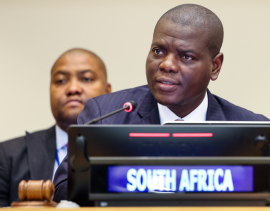
By Dikeledi Molobela
New York, USA — South Africa has stepped up efforts to establish an International Panel on Inequality (IPI), calling on United Nations member states to support a General Assembly resolution that would create a new global mechanism to assess inequality and provide evidence to guide policy responses.
International Relations and Cooperation Minister Ronald Lamola made the call on Wednesday at a high-level event on the margins of the 81st United Nations General Assembly, where South Africa joined Brazil, Norway and Spain in advancing the proposal.
The event, held under the auspices of the four countries’ leaders and with the participation of United Nations (UN) Deputy Secretary-General Amina J. Mohammed, Nobel Prize-winning economist Professor Joseph Stiglitz and other international stakeholders, sought to build support for establishing the IPI through a UN General Assembly resolution.
READ | President Ramaphosa calls for UN backing on panel on inequality
The initiative follows the work undertaken during South Africa’s G20 Presidency in 2025, when President Cyril Ramaphosa commissioned an independent committee of experts on global inequality chaired by Stiglitz.
The committee’s report, published in November 2025, identified inequality as a global concern and recommended the creation of a permanent international body capable of assessing and monitoring inequality and providing authoritative analysis to policymakers.
Opening the high-level event, Lamola said the IPI is a direct outcome of the work undertaken during South Africa’s G20 Presidency.
“This bold initiative culminated in the publication of the first-ever G20 report on inequality in November 2025,” he said.
The report examined the drivers, consequences and trends of inequality and argued that inequality was not inevitable but could be addressed through policy choices and coordinated international action. It proposed the establishment of an IPI to support governments and multilateral institutions with authoritative assessments and analysis.
Lamola said inequality had consequences extending beyond income and wealth, affecting democratic institutions, social cohesion, development and human dignity.
Inequality, he said, corrodes democracy, social cohesion, and sustainable development, while also eroding trust and undermining human dignity.
“For South Africa, inequality must be treated as a global emergency,” the Minister said, adding that addressing inequality requires action that is as urgent and coordinated.
The G20 report similarly found that inequality has implications for social and political cohesion, trust in institutions, economic stability and international cooperation, and stressed the need for collective action.
What the proposed panel will do
Lamola said the IPI would provide governments and multilateral institutions with credible, policy-relevant evidence on inequality, particularly income and wealth inequality. He said the proposed body would provide periodic assessments, convene expertise and help governments develop policies based on evidence.
“It will empower governments and multilateral institutions with credible evidence to design policies that are not only effective but also just,” he said.
The G20 expert report envisaged the IPI as a technical body centred on data and policy-relevant analysis rather than advocacy. It would monitor existing and emerging research, identify gaps in knowledge and data, and produce periodic assessments of the drivers, measurement and impacts of income and wealth inequality, including their relationship with other dimensions of inequality such as health and opportunity.
Evidence-based approach
Mohammed said the international community is confronting an inequality crisis that requires national and global responses.
“Today we are shining a spotlight on the inequality crisis. Sustainable Development Goal 10 calls on us to reduce inequality within and among nations, and yet we see breathtaking levels of income and wealth inequality, with the richest 10% of the world's population now owning 75% of all wealth,” she said.
Mohammed said inequality is also reflected in unequal access to basic needs such as housing, healthcare, nutrition and education, as well as disparities between countries.
She warned that technological developments could further deepen inequalities if the benefits and power associated with frontier technologies became concentrated in a small number of hands.
“The proposed International Panel on Inequality would bring together governments, economists, civil society, and academics to provide objective, science-based analysis and evidence on the scale and drivers of inequality, and it would put forward solutions to help policymakers address these inequalities.”
She identified areas including education, healthcare, social protection, decent work, and the governance of technology as part of the policy landscape relevant to inequality.
She also highlighted the importance of gender equality and ensuring that artificial intelligence is accessible to and governed by all countries.
Brazilian links
Brazilian Foreign Minister Mauro Vieira said Brazil had also placed inequality at the centre of its G20 Presidency in 2024, helping establish the political foundation for the initiative.
Vieira said Brazil had adopted the first G20 Ministerial Declaration on reducing inequality and launched the Global Alliance Against Hunger and Poverty during its presidency.
He said Brazil welcomed South Africa’s work during its subsequent G20 Presidency, particularly the establishment of the independent experts committee on global inequalities.
“Brazil is proud to be part of this effort, together with South Africa, Norway, Spain, and leading academics to propose the creation of an international panel on inequalities.”
Building support
Lamola said the founding committee was committed to ensuring that the establishment of the IPI proceeded through a UN member state-led intergovernmental process.
“We, as the IPI founding committee, wish to underscore our full commitment to a UN member state-led intergovernmental process through the UN's General Assembly resolution that leads to the establishment of this panel, while safeguarding the independence of its work once established,” he said.
He said South Africa and its partners had begun consultations on the proposed panel’s objectives, scope, design, financing mechanism and reporting lines.
Lamola called on UN member states to support the initiative.
Wednesday’s session was specifically convened to build support for its establishment through a General Assembly resolution.
Inequality, global rules and development
In her summary of the discussions, UNAIDS Executive Director Winnie Byanyima said participants had emphasised that inequality was shaped not only by domestic policy choices but also by international rules governing areas such as debt and taxation.
Byanyima said participants had also discussed the historical impact of colonialism and the need for better scientific data and analysis to support policymakers.
“We heard such strong welcome of the role that experts and academics on inequality can play on this issue, and the important support that this can provide to policymakers,” she said.
From G20 to the multilateral system
For South Africa, the IPI initiative represents an effort to carry the inequality agenda from the G20 into the wider multilateral system.
The objective is to build sufficient support among UN member states for a General Assembly resolution establishing the panel, followed by the development of its mandate and institutional arrangements through an intergovernmental process.
The initiative places inequality alongside other major issues on the UNGA81 agenda, including development financing, reform of the international financial architecture, climate action, technological change and efforts to advance the Sustainable Development Goals. – SAnews.gov.za


