


By Dikeledi Molobela
New York, USA - South Africa will continue to defend the principles of the United Nations Charter, international law and multilateralism, despite the challenges associated with taking a stand on global conflicts.
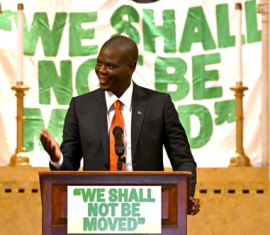
International Relations and Cooperation Minister Ronald Lamola said this on Monday while addressing a special event, “We Shall Not Be Moved: A Special Event in Honour of the UN Charter,” at The Riverside Church, in New York.
Lamola said South Africa’s own liberation struggle has demonstrated the power of international solidarity.
He said the country’s commitment to international law was reflected in its decision to approach the International Court of Justice (ICJ), the United Nations (UN) principal judicial organ, over Israel’s alleged violations of the Genocide Convention.
“When we approached the ICJ, the UN’s principal judicial organ, to challenge Israel’s violation of the Genocide Convention, we did so as part of our commitment to upholding and defending international law and multilateral institutions,” Lamola said.
He said South Africa had taken the action because it understood the impact that global solidarity had played in ending apartheid.
“In so doing, we summoned the same global solidarity that broke apartheid in South Africa to help dismantle the apartheid under which Palestinians continue to live.”
Lamola used the historic significance of The Riverside Church to frame South Africa’s current position on international peace and justice.
He recalled that civil rights leader Martin Luther King Jr. delivered his “Beyond Vietnam” speech at the church on 4 April 1967, while former President Nelson Mandela addressed a crowd at the same venue shortly after his release from prison in 1990.
Lamola said both leaders’ messages remained relevant to the current global environment.
“Sadly, as we gather here today, the words of Dr King and President Mandela speak to our times with renewed urgency,” he said.
Turning to the situation in Palestine, Lamola said Palestinians continued to face severe suffering, while Israel’s actions were threatening prospects for a two-State solution.
“For Palestinians, the age of freedom is yet to dawn. The hour of peace is yet to strike.
“And every day, Israel’s actions – the annexation of Palestinian land, the destruction of their means of life, and wanton violence in Gaza and the West Bank – threaten to crush all prospects for a two-state solution,” he said.
He said South Africa could not ignore what was happening to Palestinians.
“This is why we cannot afford to bury international law.”
He also pointed to the destruction of hospitals, schools, sanitation and water infrastructure in Gaza, and cited the psychological impact of the conflict on children.
Defending multilateralism
The Minister said South Africa’s position forms part of a broader commitment to strengthening the multilateral system and the principles underpinning the UN Charter.
“More than 80 years since its adoption, the UN Charter’s principles of fundamental human rights, the dignity and worth of every person, and the equal rights of nations, large and small, are more important than ever,” he said.
Lamola said the Hague Group represented countries working together to uphold an international order based on the rule of law.
“The Hague Group embodies that solidarity, camaraderie and shared conviction that concrete action is needed to uphold an international order based on the rule of law.”
He also linked the defence of multilateralism to broader global challenges, including inequality, the international financial architecture, climate change and Africa’s representation in global institutions.
“African countries are under-represented in institutions where decisions affecting our future are made,” Lamola said.
He said the international community is also facing major conflict and humanitarian crises, including in Sudan, the Middle East and the eastern Democratic Republic of the Congo, while the Russia-Ukraine conflict continues.
‘Silence is not golden’
The Minister acknowledged that South Africa’s position has attracted questions about whether the country should instead focus on domestic socioeconomic challenges or avoid confrontation with powerful states.
He said South Africa had nevertheless chosen to act based on its historical experience of international solidarity.
“But we choose to act because silence is not golden. In the face of grave injustice, silence is complicity.”
He said South Africa’s experience of the anti-apartheid struggle had created an obligation to support other people facing oppression.
“As one of the 20th century’s greatest beneficiaries of international solidarity, we have no choice but to act despite trial and challenges we face as a result of our choice to act in defence of humanity,” the Minister said.
He said countries supporting the cause were growing in number and reaffirmed South Africa’s determination to continue advocating for international law, peace and justice.
“Today we declare that indeed we are many. Our numbers are growing. We will not move. We shall not be moved,” Lamola said.
He concluded by invoking the historic resistance of the people of Sophiatown to apartheid-era forced removals.
“Let me conclude by borrowing another rallying cry from the people of Sophiatown, South Africa, who, a little over 70 years ago, took racial segregation head-on and declared in the face of apartheid’s bulldozers: We will not move. Ons Dak Nie. Ons Phola Hier. Amandla!” – SAnews.gov.za


