


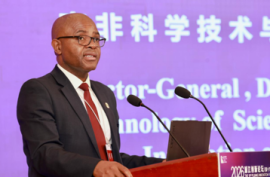
Shanghai, China -South Africa must close the funding gap that prevents promising scientific research from being converted into commercially viable products and services, says Department of Science, Technology and Innovation Director-General Mlungisi Cele.
Speaking on the sidelines of the 19th Pujiang Innovation Forum in Shanghai, Dr Cele said researchers were producing potentially valuable technologies, but many projects struggled to move beyond the laboratory and into the economy.
He described this difficult transition as the “valley of death”, saying “it requires a massive injection of funding”.
“The challenge in South Africa is that many projects are unable to progress. Some may reach the early stages of financing, but they cannot secure the funding required to move further,” said the Director-General (DG).
This meant that research supported by the government and undertaken at universities, science councils and other institutions could fail to reach the people and industries that needed it.
Closing the commercialisation gap would require the government and private sector to share the cost and risk of developing new technologies, Cele said.
He argued that the State had a particular responsibility to support innovations that were strategically important but considered too risky by conventional investors.
“The State must be prepared to invest in initiatives and projects that are high-risk. It must be fearless while also attracting private-sector investment.”
Cele described greater government funding and increased private investment as a “twin strategy” for advancing South African innovations.
“That is the twin strategy: getting more investment from government, while also attracting capital from our businesses and local companies.
“We must encourage private investment at the stage when projects are not yet attractive to conventional investors. This stage is quite expensive, and that is why we really need the private sector to work with us,” he explained.
Private investors were often reluctant to finance technologies that had not yet demonstrated their commercial viability. This left researchers without the capital required to test, refine, manufacture and introduce their innovations to the market.
The DG said South Africa could learn from China’s ability to connect scientific research, industrial development and private-sector investment. However, South Africa would have to build a model suited to its own economy and research capabilities.
“We do not pretend that we can become like China within three years. China has its own capabilities, but we have also demonstrated our capabilities in certain areas.”
International cooperation would remain an important part of this effort. Partnerships with countries such as China could give South African researchers access to expertise, scientific instruments, software and other technologies needed to advance their work.
Cele cautioned, however, that South Africa should not become dependent on a single international partner for critical research funding or technology.
“Current geopolitics has taught us that a country cannot depend on one country for technologies.”
He pointed to the impact of the withdrawal of some United States of America funding on research into HIV and other diseases as an example of the risks created by excessive reliance on external support.
“Last year, the United States withdrew some of its funding, and it affected research into HIV and a range of other diseases. We had depended on that support without planning for what would happen if it was withdrawn,” Cele said.
Building the capacity to finance and commercialise locally developed technologies was therefore not only an economic priority but also a matter of national sovereignty.
“When we talk about sovereignty, this is one of the challenges. We want South Africa to be able to determine its own future without being subjected to external pressure,” he said.
South Africa’s challenge, Cele said, was to use international partnerships to strengthen domestic capabilities while mobilising local public and private capital.
A stronger commercialisation system would allow the country to convert more of its scientific knowledge into businesses, services, industrial technologies and solutions to social challenges.
“The Minister is working to establish a coordinated approach to setting a science, technology and innovation agenda that will enable us to stand on our own,” Cele said.
Meanwhile, China has reaffirmed its commitment to strengthening science, technology and innovation cooperation with South Africa as the two countries work to give practical effect to their upgraded strategic partnership.
READ | China seeks deeper science and innovation cooperation with SA
The forum runs from 11 – 14 September and includes exhibitions, discussions and bilateral engagements involving governments, universities, science councils and the private sector. -SAnews.gov.za


