


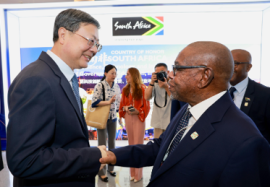
Shanghai, China -China has reaffirmed its commitment to strengthening science, technology and innovation cooperation with South Africa as the two countries work to give practical effect to their upgraded strategic partnership.
Addressing the 19th Pujiang Innovation Forum in Shanghai, China’s Minister of Science and Technology, Yin Hejun, said South Africa’s prominent participation demonstrated the importance both countries attached to their scientific relationship.
“It demonstrates the high importance that South Africa attaches to the forum and to furthering scientific and innovation cooperation between China and South Africa,” Yin said.
He described China and South Africa as important emerging markets and major developing countries whose cooperation could contribute to scientific advancement and efforts to address global development challenges.
In September 2024, the two countries elevated their bilateral relationship to an all-round strategic cooperative partnership in the new era.
Yin said the development had created further opportunities to expand bilateral cooperation in science and innovation.
He said Shanghai, which is hosting the forum, was an important centre of China’s scientific and technological development, with innovation among the city’s defining features.
Its innovation ecosystem continued to attract researchers and produce advances in fields including artificial intelligence (AI), biopharmaceuticals and brain-computer interfaces.
“Shanghai’s innovation ecosystem continues to improve. It continues to attract global researchers and, in many key areas such as AI, biopharmaceuticals and brain-computer interfaces, new results keep emerging,” Yin said.
China was also strengthening cooperation between Shanghai and surrounding provinces in the Yangtze River Delta to develop the region into an internationally competitive science and technology innovation hub.
Yin said national science and technology strategies were working in tandem with Shanghai’s trade and investment policies to unlock further development opportunities.
China was increasing investment in innovation, strengthening its strategic scientific capabilities and pursuing breakthroughs in basic research and key technologies.
The country’s research and development expenditure had exceeded 3.92 trillion yuan, with research intensity reaching approximately 2.8% of its gross domestic product (GDP).
According to Yin, China had also performed strongly in Patent Cooperation Treaty applications and research published in high-level international journals.
“According to our National Innovation Index report, China’s comprehensive innovation capability ranks ninth globally. “China is progressively transitioning from a global science and technology participant into a contributor and leader.”
He added that the latest scientific and industrial revolution offered countries important opportunities to promote sustainable development and respond to common challenges.
However, breakthroughs in artificial intelligence, quantum technology and other emerging fields also presented significant ethical and governance risks.
“Technology is also a double-edged sword. We need to address questions such as violations of privacy, the abuse of data and fragmented global governance mechanisms,” Yin said.
Governance and cooperation
He called for an inclusive international science and technology governance system that would promote innovation while managing its potential risks.
Greater international cooperation was particularly important in basic research because major discoveries frequently emerged through exchanges between scientists from different countries.
“Many major scientific discoveries stem from the exchange of ideas and the clash of opinions between scientists,” Yin said.
“We need to seize the opportunities presented by the new round of scientific and technological revolution through international collaboration and integration, expand the horizons of knowledge and make more breakthroughs from zero to one.”
Yin said international scientific cooperation would also be essential to addressing climate change, environmental degradation, energy security and public safety.
“We need to use innovation resources efficiently and explore new pathways for effective scientific innovation so that we can offer more solutions for global sustainable development,” he said.
Meanwhile, South Africa’s Minister of Science, Technology and Innovation Professor Blade Nzimande said South Africa and China would pursue closer collaboration in “artificial intelligence, joint research centres, space science and astronomy, quantum computing, cybersecurity, public engagement, youth development and the Young Scientists Exchange Programme”.
Cooperation between the two countries is governed by a science and technology agreement signed in 1999, during former President Nelson Mandela’s administration. It has since expanded into health, traditional medicine, astronomy, forestry, palaeontology and energy research.
READ | Global South must co-own technologies of the future – Nzimande
“Our cooperation with the People’s Republic of China remains a critical component of our bilateral relationship,” Nzimande said, adding that the partnership was rooted in “solidarity, development cooperation and multilateral engagement,” said Nzimande. -SAnews.gov.za


