


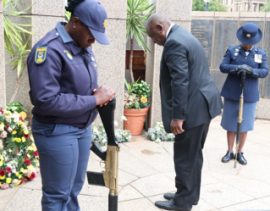
Beyond the names of the 12 police officers remembered at the Union Buildings on Sunday, stand families whose lives were changed forever.
From a mother of three to a father whose death left behind seven-month-old twins, the stories of this year’s fallen police officers brought home the human cost of attacks on those entrusted with protecting South Africans.
President Cyril Ramaphosa described the South African Police Service (SAPS) National Commemoration Day as a national covenant of remembrance, accountability and renewal -- a commitment to honour those who made the ultimate sacrifice and to stand with the families they left behind.
“This year, we remember 12 members who lost their lives in the line of duty during the last financial year. Nine of these members were from Gauteng, with one each from the North West, KwaZulu-Natal and Mpumalanga,” President Ramaphosa said.
The annual commemoration is held on the first Sunday of September to remember police officers who died in the line of duty during the preceding 12 months. This year’s ceremony honoured the 12 members, who died between 1 April 2025 and 31 March 2026.
For the families gathered at the Union Buildings, the day was about much more than a ceremony. President Ramaphosa said among them was a wife who was pregnant when her husband was killed, while another family lost a father and husband, who left behind infant twins.
Among the 12 fallen members was also the only woman on this year’s Roll of Honour – a mother of three from Temba Police Station.
The President said these personal stories should force the country to confront the circumstances in which police officers are being killed.
“Behind every police killing is a family story that has been permanently rewritten. The circumstances of these deaths should concern us deeply.”
Several of the officers were killed while working the same shift, responding to business robbery complaints or transporting awaiting-trial prisoners. Others died while carrying out routine crime prevention and patrol duties in their own precincts.
The youngest was just 25 years old.
“Today we remember them not as statistics, but as sons and daughters, mothers and fathers, colleagues and friends, who went to work to protect their fellow South Africans and never returned home,” President Ramaphosa said.
The 12 members being remembered are Constable Gift Mota, Sergeant Sello Raymond Sema, Sergeant Matome Rapetsoa, Sergeant Simon Masenye, Constable Mwazkhe Khoza, Warrant Officer Mosesi Moswana, Constable Moselalelelo Montja, Constable George Hlekiso, Sergeant Sanele Dlamini, Warrant Officer Vuyisile Sintwa, Constable Sharon Hlangoane and Sergeant Lawrence Mtsweni.
Their names have been added to the Roll of Honour, ensuring that their service and sacrifice remain part of the nation’s memory.
Collectively building safer communities
President Ramaphosa challenged South Africans to look beyond the immediate response to police killings, and consider the kind of society the country wants to build.
“We must confront a difficult question: what kind of society kills those entrusted to protect it, and what must we do to change it? When criminals target a police officer, they are attacking the integrity of the State, the rule of law and the constitutional order,” he said.
The President said attacks on police officers are therefore an attack not only on individuals, but on the people of South Africa.
“Our response must extend beyond enforcement. The fight against crime must become a project of responsible citizenship, respecting the law, rejecting corruption, reporting criminality and teaching our children that respect for human life is the foundation of a stable democracy.”
This, he said, requires investment in families, schools, early childhood development, youth programmes and sport to build resilience before young people become vulnerable to criminal networks.
While the number of police officers killed in the line of duty has declined significantly in recent years, the President stressed that even one life lost is one too many.
“This reflects the progress of operational interventions, police safety initiatives, community partnerships, and cooperation across government and with the private sector.”
Supporting life after tragedy
He also called for stronger partnerships with the private sector to support the children left behind by fallen officers.
Since its establishment in 2010, the South African Police Service Education Trust (SAPSET) has supported 2 215 children of fallen police officers, with more than R25 million raised through sponsorships.
“This investment changes lives. Children, who once faced uncertainty, have graduated. Some have obtained Master’s and PhD degrees,” Ramaphosa said.
He appealed directly to corporate South Africa to support SAPSET through sustainable donations and scholarship programmes, helping children transform the experience of loss into opportunity.
For the families of the fallen, however, no amount of support can replace the loved ones they lost.
“No ceremony can replace a husband or wife. No pension can compensate for the loss of a father or mother, and no tribute can return a parent to their children.
“But we can ensure that their service is never forgotten and that their families remain part of the national family,” the President said.
To the children of the fallen officers, the President said their parents had left them more than memories.
“They left you a legacy of courage, duty and service. Carry their names with pride and build lives worthy of their sacrifice.”
To the men and women who continue to wear the SAPS uniform, President Ramaphosa said the nation sees their courage and recognises the demands of their profession.
The President urged the nation to ensure that those who protect South Africa are themselves protected by the society they serve. – SAnews.gov.za


