


For more than four decades, the Simelane family has lived with a silence that no family should have to endure: the absence of a daughter, a sister and a young woman whose life was cut short by the machinery of apartheid, yet whose story refuses to disappear.
On Thursday, that silence met a packed Great Hall at the University of Mpumalanga in Mbombela, where the memory of Nokuthula Simelane was transformed into something larger than remembrance: a national conversation about justice, accountability, gender equality and the responsibility of a new generation to remember what came before them.
For the family, the occasion carried the weight of a homecoming. Born and bred in Bethal, Nokuthula's story returned to the province where her roots were planted, more than 40 years after she was abducted at the age of 23 and disappeared.
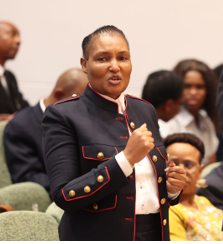
Her younger sister, Thembi Simelane, who is currently serving as the Minister of Human Settlements, stood at the centre of that history, carrying not only the memory of a sibling but the burden of a family that has never been able to perform the final rituals of laying their loved one to rest.
Speaking to SAnews, Minister Simelane said that her sister disappeared after she was sent from Swaziland to a mission in South Africa.
“Subsequently, we went through the TRC [Truth and Reconciliation Commission] process, which identified special branch police who were responsible. Unfortunately, even with that step, we still have not been able to find her remains.
“We do hope that keeping her memory alive will make us not forget that she lived, because we have no grave to visit, we have no way of performing our Simelane customs and rituals to bury a loved one, but we carry a responsibility of keeping her spirit alive,” the Minister said.
That responsibility has now taken institutional form through the launch of the Nokuthula Simelane Foundation and the inaugural Nokuthula Simelane Memorial Lecture, an annual platform intended to ensure that her story is not confined to the past, but becomes part of South Africa's continuing conversation about democracy, human rights and social justice.
For media spokesperson of the Foundation, Thembisa Mdoda, 3 September 2026, represents more than the launch of an organisation or a lecture series. It was, she said, a moment in which a family's decades-long pain could become a catalyst for a much bigger national reckoning.
“I think this is a special day because over 40 years ago we lost our sister Nokuthula. She was a stalwart in the struggle, and she disappeared without a trace. And since that day, her family has been looking for her,” Mdoda said.
With approximately 1 200 people expected at the inaugural lecture, including government leaders, academics, students, civil society, liberation veterans and human rights practitioners, Nokuthula's name is being deliberately carried into spaces where history can be interrogated, taught and kept alive.
“This today sparks a big dialogue, a conversation where families have missing children, families have missing siblings that are nowhere to be found, and no one has taken accountability. So today we talk about equality, we talk about gender equality, we talk about justice, and we also talk about those that are missing that no one has even looked for,” Mdoda said.
The significance of the day is heightened by the presence of President Cyril Ramaphosa, who is scheduled to deliver the inaugural Memorial Lecture today, while the University of Mpumalanga and the Foundation began laying the groundwork for a longer-term academic legacy that could see Nokuthula's name attached not only to an annual lecture, but to research, education, heritage preservation and a proposed Centre for Gender and Intersectional Studies.
READ | President Ramaphosa to deliver inaugural Nokuthula Simelane Memorial Lecture
It is an attempt to turn an unresolved absence into an enduring presence.
Nokuthula's remains have never been recovered. But her name, her courage and the questions surrounding her disappearance are being carried forward from one generation to another, from a family searching for closure to a country still confronting the unfinished business of its past.
As Mdoda put it: “We put our fists up for Nokuthula Simelane. The struggle continues, but we will have victory.” – SAnews.gov.za


