


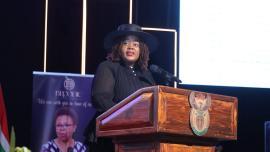
Minister of Justice and Constitutional Development Mmamoloko Kubayi has paid tribute to Justice Fikile Eunice Mokgohloa, honouring her contribution to the development of South African jurisprudence and the role her judgments played in easing the burden of poverty and inequality for poor and vulnerable communities.
“Justice Mokgohloa’s passing is a profound loss to the Judiciary, the legal profession and the people of South Africa. She dedicated her life to the creation of a just society and for that the country owes her a huge debt of gratitude,” the Minister said on Saturday in Pretoria.
Justice Mokgohloa was honoured with a Special Official Funeral Category 2, as declared by President Cyril Ramaphosa, in recognition of her distinguished service to the nation and the judiciary over the past 20 years.
She passed away on 20 August 2026 at the age of 65 while serving as a Judge of the Supreme Court of Appeal, a position she had occupied since June 2019 after serving as Deputy Judge President of the Limpopo Division of the High Court.
She had also served as Acting Deputy President of the Supreme Court of Appeal.
Delivering Justice Mokgohloa’s eulogy, Kubayi highlighted the accomplishments that helped shape South Africa’s young democracy and advance women’s empowerment.
“We are also here to celebrate that the girl child from Pretoria, born in 1961 at the height of apartheid, managed to obtain her B Juris and LLB degrees, and rose to become a judge of the Supreme Court of Appeal. Her accomplishments are an inspiration to other women and girls, because her brilliance and determination empowered her to traverse the uncharted territory of a male-dominated judiciary as a woman jurist, and she defied the stereotypes.
“Justice Mokgohloa understood that the drafters of the constitution, which this year we are celebrating the 30-year anniversary of its adoption, framed the constitution to be transformative with the aim of creating a new society that is socially just,” the Minister said.
Kubayi said Justice Mokgohloa’s judgments showed a deep understanding of social justice: that everyone deserves the same rights, protections and opportunities to succeed, regardless of background.
In the matter of Mchunu and Others v Executive Mayor, eThekwini Municipality and Others, Justice Mokgohloa ruled in favour of slum dwellers who had been illegally evicted by the eThekwini Municipality.
“In this judgment, Judge Mokgohloa struck down a temporary court order that had been used by the MEC and the Durban Municipality to evict thousands of poor people from informal settlements in Durban, rendering them homeless.
“The judgment represented progress towards a more just society for the people who must live with the burden of inequality. This judgment also pushed for the alignment of public policy to tackle systemic inequalities, ensuring that constitutional promises of dignity and equality translate into material well-being,” Kubayi said.
The Minister also reflected on the TM v ZJ case, in which Justice Mokgohloa adjudicated a matter involving a couple married under Islamic law whose marriage had not been registered in terms of the Marriage Act.
“As part of the divorce settlement, the wife was seeking custody of their two children, maintenance and contribution towards legal costs before the finalisation of divorce proceedings.
“The husband was not willing to accede to these demands, arguing that the marriage had already been terminated by his pronouncing talaq, which is the unilateral pronouncement by the husband that he is divorcing his wife, uttered three times,” Kubayi said.
In her ruling, Justice Mokgohloa found that the wife “cannot be precluded from obtaining relief in terms of the Marriage Act by virtue of her Muslim marriage, irrespective of whether the respondent pronounced a talaq or not.
“In this judgment, she communicated the message that said that our respect for religious rights cannot trump fairness and the right to dignity. Rights must be balanced in such a way that the outcomes do not leave any of the parties in a worse-off position.
“She also demonstrated that women judges bring vital lived experiences to the bench, helping to shape how courts interpret equality, address gender-based violence, and deliver fair justice,” the Minister said.
Kubayi said Justice Mokgohloa’s judgments affirmed that building a culture in which socio-economic rights, including the right to housing and the right to equality, are respected requires unwavering fidelity to the Constitution. -SAnews.gov.za


