


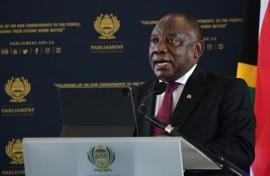
President Cyril Ramaphosa says South Africa remains a respected member of the African community of nations and a principled Pan-African actor, despite concerns raised by some African countries concerning migration-related matters.
The President was responding to questions in Parliament on Tuesday on South Africa's standing on the continent and the measures government is taking to restore confidence in the country as a Pan-African voice.
President Ramaphosa said government has firmly rejected xenophobia, Afrophobia, vigilantism and all forms of discrimination against people from other countries.
“South Africa remains a respected member of the African Community of Nations and a principled Pan-African actor. We continue to participate actively in continental as well as regional bodies and processes, while some African countries have raised concerns about the anti-migrant actions by some groups in our country. As a government, we have firmly and publicly rejected xenophobia, Afrophobia, vigilantism, and all forms of discrimination against people from other countries,” he said.
South Africa has reinforced its commitment to Pan-Africanism through cooperation with the Southern African Development Community (SADC), the African Union (AU) and partner States on migration governance, regional integration and burden sharing.
The President said government has also engaged directly with a number of Heads of State and Government to explain South Africa's position and approach to migration.
He highlighted the 46th Ordinary SADC Summit, which South Africa hosted in eThekwini earlier this month, saying government had proactively placed migration on the agenda, rather than waiting for regional leaders to raise concerns.
“Last week, at the 46th Ordinary SADC summit that we hosted in eThekwini, we took the opportunity to brief the leaders of the region on the situation in the country, and this we did without being asked either to account or to explain. We took it upon ourselves to put the matter on the agenda, and I also addressed it in my inputs and we explained precisely what the situation had been in our country,” President Ramaphosa said.
He said the approach had allowed South Africa to explain the measures it was taking, while also encouraging the region to work collectively on the broader migration challenge.
“In its communiqué, the summit called for a coordinated and multidimensional dialogue at the regional level to address the underlying drivers of migration and develop comprehensive, sustainable, and effective responses,” he said.
Comprehensive approach to migration
President Ramaphosa said government is pursuing a comprehensive approach to migration management based on the rule of law, respect for human dignity and stronger State institutions.
He said this includes reforming and modernising the country's migration governance framework through stronger border management, action against corruption within the immigration system, improved legal migration pathways and implementation of the White Paper on Citizenship, Migration and Refugee Protection.
“Through our comprehensive approach to managing migration, we have emphasised that migration challenges must be addressed through the rule of law, respect for human dignity, and the strengthening of State institutions, not through unlawful actions targeting foreign nationals.
“An important part of this approach is the reform and modernisation of South Africa's migration governance framework, and this includes strengthening border management, addressing corruption within the immigration system, improving legal migration pathways, and implementing the white paper on citizenship, migration, and refugee protection,” he said.
The President said the measures were intended to strengthen public confidence in the state's ability to manage migration while ensuring that South Africa continued to uphold its constitutional and international obligations.
He also rejected suggestions that South Africa was becoming isolated diplomatically as a result of tensions over migration and attacks against foreign nationals.
President Ramaphosa said International Relations and Cooperation Minister Ronald Lamola had travelled to a number of countries as his Special Envoy, meeting Heads of State and Government to discuss the situation.
He acknowledged that coordinating meetings with foreign leaders could sometimes be difficult, but said the engagements had generally been positive.
“He was well received in Ghana… [and] other countries. We've had discussions even at my level with various Heads of States, who have articulated their deep understanding for what has been happening here, and they have wished as well, and they have said that they are willing and able support South Africa as it deals with this difficult problem, and they have also characterised it as a complex problem, meaning that there is deep understanding of the challenges we are going through,” he said.
President Ramaphosa said the diplomatic engagements have demonstrated that South Africa is not being isolated on the continent.
“While other people might have thought that we are being snubbed and we are being isolated, actually the contrary has been the case.
“As we have sat down to explain precisely the challenges that we are going through, we have found, to our pleasant appreciation, that there is understanding and there is support, and a number of countries are saying they are willing to work with us to have this problem resolved,” he said.
The President said South Africa would continue to advocate for collective African solutions to migration, while engaging diplomatically with countries that had concerns about developments in the country. - SAnews.gov.za


