


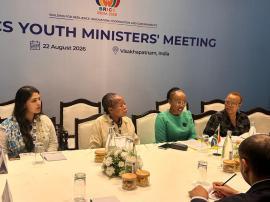
Minister in the Presidency responsible for Women, Youth and Persons with Disabilities Sindisiwe Chikunga has called for stronger cooperation among BRICS countries to equip young people with the skills, opportunities and support needed to thrive in a rapidly changing global economy.
Addressing the Brazil, Russia, India, China and South Africa (BRICS) Youth Ministerial Meeting in Visakhapatnam, India, on Saturday, Chikunga said young people across the world continue to face unemployment, poverty, inequality, skills mismatches, and uneven effects of technological and economic change.
She said these challenges require deeper cooperation among BRICS nations in areas such as skills development, entrepreneurship, innovation, digital transformation, education, and youth leadership.
“By investing in youth today, we invest in the resilience, prosperity and sustainability of our nations tomorrow,” Chikunga said.
The Minister held a bilateral meeting with United Arab Emirates (UAE) Minister of State for Youth Affairs, Dr Sultan bin Saif Al Neyadi, aimed at strengthening South Africa–UAE cooperation in youth empowerment, and skills development.
Chikunga said the meeting reflected the shared commitment of BRICS nations to place young people at the centre of global development.
Prevailing global context
Turning to the global context, Chikunga noted that young people continue to face the challenges of unemployment, poverty, inequality, skills mismatches, and uneven impacts of technological and economic change.
She said these realities demand stronger cooperation among countries to ensure that youth are equipped with the skills, opportunities and support.
“With only 12% of the Sustainable Development Goals (SDG) targets on track to be met by 2030, the current global reality is untenable, undesirable and unsustainable. All of this makes our meeting particularly significant,” Chikunga said.
Chikunga highlighted South Africa’s investments in youth development through the National Youth Development Agency and the National Youth Service Programme, which have expanded opportunities for volunteerism, civic participation, entrepreneurship and employment support.
She said volunteerism remains an important instrument for promoting social cohesion, active citizenship and people-to-people cooperation among BRICS countries.
The Minister also noted President Cyril Ramaphosa’s announcement of the implementation of paid voluntary work targeting 100 000 young people in 2026.
Investment in basic and higher education
On education, the Minister highlighted government investment over the past three decades, with expanded access to basic and higher education, and improved opportunities for young people from disadvantaged backgrounds.
“At basic education level, in 1994, the matric pass rate stood at around 58%. Three decades later, the Class of 2025 achieved a record breaking National Senior Certificate (NSC) pass rate of 88%. This is the result of three decades of making education an apex priority of government.
“In higher education and training, we have also honoured the call for the doors of learning and culture to be opened, through the National Student Financial Aid Scheme (NSFAS).
“From its humble beginnings in the early 1990s, NSFAS has grown from a budget of R33 million in 1991, serving only 7 240 students, to a budget well over R50 billion in 2026, funding over 1.1 million students at universities and Technical and Vocational Education and Training (TVET) colleges,” Chikunga said.
The Minister also highlighted the role of South Africa’s social protection programmes, saying they continue to cushion vulnerable young people and their families against poverty and support access to education and economic participation.
Chikunga said the inclusion of young persons with disabilities should also remain a key priority within the BRICS Youth Track.
“We must ensure that young persons with disabilities have equal access to education, skills development, employment opportunities, entrepreneurship support, digital technologies and leadership platforms,” the Minister said.
The Minister emphasised that an inclusive BRICS youth agenda should recognise the contributions of all young people, including women, rural youth, and persons with disabilities.
She reaffirmed South Africa’s commitment to peace, stability, and development as essential conditions for young people to realise their full potential.
The Minister welcomed the adoption of the Joint Statement of the BRICS Youth Ministers’ Meeting and the BRICS Youth Cooperation Framework.
“These instruments provide an important basis for continuity, structured cooperation and practical initiatives that will strengthen the BRICS Youth Track and enhance opportunities for our young people. As BRICS continues to evolve, let us ensure that the voices, aspirations, and innovations of young people remain at the heart of our collective agenda,” Chikunga said. – SAnews.gov.za


