


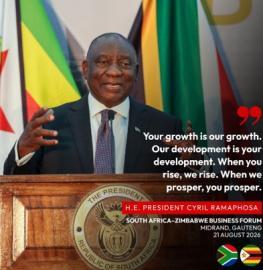
President Cyril Ramaphosa has called on South African and Zimbabwean businesses to move beyond trading across borders and instead build joint industries, invest in infrastructure and unlock value from the two countries’ natural resources.
Addressing the South Africa–Zimbabwe Bi-National Commission Business Forum in Midrand on Friday, President Ramaphosa said stronger economic integration between the neighbouring countries should translate into investment, industrial development and jobs, particularly for women and young people.
“Today, solidarity means jobs, investment and a trading relationship that benefits both our peoples,” the President said.
He said bilateral trade had grown significantly, reaching R81 billion in 2025, nearly double its 2021 level.
Zimbabwe is South Africa’s second-largest export destination on the African continent, while South Africa is Zimbabwe’s largest single source of imports from the rest of the world.
However, President Ramaphosa said the trade relationship remained heavily imbalanced, with the value of South African exports to Zimbabwe roughly eight times higher than imports from Zimbabwe.
“Much of what South Africa sends over the Limpopo are finished goods: vehicles, earthmoving equipment, industrial cleaning and mining products.
“Zimbabwe sends raw and semi-processed material south: coal and coke products, chromium ore, gold, semi-finished steel and raw tobacco,” he said.
President Ramaphosa said the two countries needed to change this pattern by using the African Continental Free Trade Area (AfCFTA) to strengthen industrialisation, expand intra-African trade and create employment.
“Through the African Continental Free Trade Area we can expand trade between African countries. We can put our natural resources to better use. We can develop our industries and create more jobs for our people,” he said.
Business key to turning agreements into jobs
The President stressed that while governments create the policy environment and sign agreements, businesses are responsible for turning those commitments into investment and economic activity.
“Governments can determine policy, sign agreements and ratify protocols, but it is business that turns a signed agreement into a shipment, a factory or a job.
“Governments can align customs procedures and standardise regulations, but it is business that produces the goods and carries them across borders,” the President said.
He said South Africa viewed Zimbabwe as a key regional market and remained optimistic about the Zimbabwean economy, citing strong growth in 2025 driven by mining and agriculture.
President Ramaphosa said greater economic stability would also provide the predictability needed by South African exporters and investors to commit capital at scale.
Beitbridge and regional corridors
Infrastructure development was another key focus of the President’s address, particularly efforts to improve the movement of goods between the two countries.
He highlighted progress at the Beitbridge Border Post, the main commercial border between South Africa and Zimbabwe, where modernisation through public-private partnerships and dedicated traffic lanes has helped reduce average truck crossing times to roughly 14 hours.
“The One-Stop Border Post is under development. Customs processes are being aligned,” he said.
President Ramaphosa said these improvements formed part of a much broader vision for regional trade corridors linking the Port of Durban with the Democratic Republic of the Congo.
“These advances are not confined to the bridge that crosses the Limpopo River. They are part of a far broader vision of a corridor that links the Port of Durban in the south to the Democratic Republic of the Congo in the north,” he said.
He said the region should develop corridors that serve not only as routes for traded goods, but as platforms for industrialisation, commerce and employment. – SAnews.gov.za


