


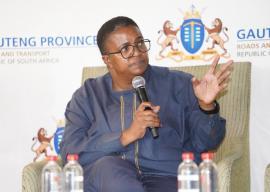
Deputy Minister in the Presidency for Women, Youth and Persons with Disabilities Mmapaseka Steve Letsike has called for a shift from merely ensuring women's participation in the economy to placing greater emphasis on ownership, wealth creation and economic power.
Letsike noted that while South Africa has made significant progress in opening spaces for women in Parliament, universities, boardrooms and industries from which they had historically been excluded, the next stage of women's economic emancipation must focus on ownership.
“For me, the next stage of women's economic emancipation must be about moving from participation to power,” Letsike said.
Addressing the Ascend Her Business Conference in Sandton on Friday, she said women can participate in the economy without having meaningful economic power, indicating the difficulties many entrepreneurs face in accessing capital, owning productive assets and accumulating wealth.
“A woman can register a company but struggle to obtain capital. She can win a contract but not own the equipment required to deliver it. She can distribute somebody else's products without ever becoming a producer herself.”
She said the country needs to be more demanding about what it means by women's economic empowerment, arguing that the focus should not only be on preparing women to succeed in the economy, but also on transforming the economy itself.
“Real economic transformation must therefore concern itself not only with what women earn, but increasingly with what women own.”
Letsike said African women historically have demonstrated entrepreneurship and resilience by trading, farming, organising stokvels and cooperatives, and creating livelihoods under difficult circumstances.
The challenge is to ensure that women's ambition is supported by an economy that creates meaningful opportunities for growth and ownership.
This requires confronting questions around access to finance, collateral, land, procurement opportunities and the business networks where important economic decisions are made.
The Deputy Minister also called on government, the private sector, development finance institutions and entrepreneurs to play their part in creating conditions that enable women-owned businesses to grow.
Businesses need access to capital, markets and opportunities, she said, adding that government and corporate procurement could either reinforce existing economic patterns or help transform ownership and production.
“Our ambition must go beyond producing a permanent class of women subcontractors. At some point, the subcontractor must become the principal contractor. The distributor must become the manufacturer.”
The Deputy Minister also emphasised the importance of ensuring that women participate as owners and creators in emerging industries and technologies.
She said artificial intelligence, renewable energy, financial technology and digital commerce were already reshaping the economy and warned against allowing inequalities from the old economy to be replicated in new sectors.
“We need women building technology, owning intellectual property, manufacturing, investing and creating enterprises that can compete across our continent. The future cannot simply be something that African women enter after somebody else has built it. African women must be among those who build it.”
Letsike called for greater economic solidarity among women, encouraging successful entrepreneurs to support others by buying from women-owned businesses, sharing opportunities, making introductions and opening doors.
“Perhaps, then, the next evolution of women's solidarity is that our solidarity must become economic infrastructure.”
She urged the Ascend Her graduates to build profitable businesses, own assets and create wealth, while also using their success to create opportunities for others. – SAnews.gov.za


