


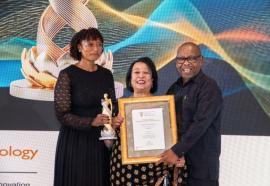
Science, Technology and Innovation Minister, Professor Blade Nzimande, has warned that South Africa cannot reach its full potential if women and girls remain excluded from opportunities in science, technology and innovation.
In his opening remarks at the 23rd South African Women in Science Awards (SAWiSA) Gala Dinner in Sandton, Johannesburg, on Thursday evening, Nzimande said the 2026 theme: “Placing Women at the Centre of Science, Technology and Innovation”, highlighted the need to confront persistent structural inequalities in the country's science system.
“Transformation is not a symbolic gesture, but a moral and strategic necessity,” Nzimande said.
Nzimande highlighted South Africa’s progress in improving women's participation in science and research, with women now constituting 52% of the academic workforce and 47.7% of the national research workforce.
Women also accounted for 62.6% of total university enrolments in 2024.
The Minister said government had institutionalised equity targets requiring at least 55% of postgraduate bursaries to be awarded to women and 80% to Black students.
During the 2025/26 financial year, 6 246 postgraduate students received bursary support, while 1 644 emerging researchers were supported, including 708 Black women emerging researchers.
Nzimande said the South African Research Chairs Initiative is also being used to advance the empowerment of women, with 104 of the 198 operational research chairs, or 53%, held by women as of April 2026.
Despite these gains, the Minister said the country's transformation journey remained incomplete.
“Women remain underrepresented in research leadership and critical STEM (Science, Technology, Engineering, and Mathematics) disciplines like engineering, computer science, and AI [artificial intelligence].
“Early-career researchers face heavy structural barriers, from intense teaching loads to limited research time. Paradoxically, while women lead institutional research, female-owned tech enterprises face severe venture capital deficiencies,” the Minister said.
To address these challenges, Nzimande said the Department of Science, Technology and Innovation and the Technology Innovation (DSTI) Agency are steadfast in providing targeted seed funding, incubation and venture capital to female-led technological enterprises.
“Our objective is to empower women not just as high-calibre researchers and scientists, but as enterprise founders and industrial pioneers. Meaningful transformation cannot end with a published paper; it must extend into intellectual property, patents, and global market leadership,” Nzimande said.
Nzimande said the impact of the SAWiSA 2026 theme should ultimately be reflected in a significant increase in the participation of women and girls in STEM over the next 10 to 20 years.
Honouring late renowned “ProfKeo”
The Minister also announced that one of the award categories will be renamed the DSTI-Professor Keolebogile Shirley Motaung Fellowship, in honour of the late renowned scientist.
Motaung, affectionately known as ProfKeo, was a pioneer in stem cells and regenerative medicine, with a strong emphasis on indigenous knowledge systems.
Nzimande said the decision followed a commitment made to her family to find a lasting way of honouring her contribution to science.
He also congratulated Professors Liesl Zühlke, Priscilla Baker and Karen Sliwa-Hahnl for receiving national and international recognition for their contributions in various scientific fields.
The SAWiSA awards celebrate excellence across the natural, life, physical and engineering sciences, as well as the humanities and social sciences, public engagement with science and innovation for impact.
The awards also seek to strengthen the pipeline of future women scientists through fellowships for master's and doctoral students.
Nzimande said hosting the awards during Women's Month was particularly significant, given South Africa's history in which women, especially Black women, were excluded from education, science and economic opportunities under apartheid.
He said the awards honoured the struggles of South African women against racism, sexism and other forms of discrimination, while encouraging young women to enter STEM fields and supporting those already pursuing careers in science.
“No nation can hope to achieve its national development goals if it fails to invest in building its scientific and technological capabilities. No nation can ever hope to reach its true potential if it excludes its women and girls from opportunities in science, technology, and innovation,” Nzimande said. – SAnews.gov.za


