


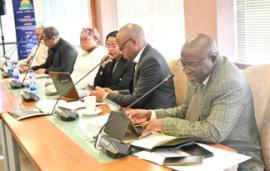
Chief Executive Officers (CEOs) of Special Economic Zones (SEZs) have been urged to ensure that SEZ’s create job opportunities, particularly for the country’s young people.
This was the call made by the Chairperson of the Special Economic Zones Advisory Board, Fish Mahlalela, at the two-day SEZs CEOs Forum that was held at the Coega SEZ in Gqeberha, Eastern Cape, from 18-19 August 2026.
“I am convinced that what was discussed here over the two days will manifest itself in the work on the ground that all of you will be able to implement as part of your plans to use the SEZs to change the economy of your provinces.
“These plans must enable you to contribute to creating jobs in your areas, using the SEZs as centres of industrialisation, hubs of manufacturing and academies of skills development. SEZs should provide infrastructure and unlock opportunities for micro, small, and medium enterprises that are critical in creating these jobs,” Mahlalela said.
At the forum hosted by the Department of Trade, Industry and Competition (the dtic), Mahlalela cautioned that the forum took place at a critical time when the country was battling with a crisis of youth unemployment.
The purpose of the forum was to discuss the alignment of the implementation plans of the SEZs with the five-year implementation plan of the new Spatial Industrial Development strategy.
“If the crisis of youth unemployment is not attended to it may result in unpleasant consequences. Unemployment in the country is extremely high, and if no intervention is done, we might find ourselves in a very difficult situation.
“Therefore, SEZs become one of the key elements in the broader scheme of things to change this situation. SEZs should assist in intervening and addressing this crisis. There is a huge expectation for the SEZs to make sure that they contribute and assist the country in addressing this problem of unemployment, especially youth unemployment,” Mahlalela explained.
He also urged CEOs to set up skills academies in all the SEZs as part of the new SEZs model advocated by the Spatial Industrial Development (SID) Strategy.
He also called on SEZs to prioritise community involvement and participation.
“No one should be left behind in the implementation of these plans. It is fundamental that we move along with the local people so that they appreciate the work that the SEZs are doing. This will enable them to provide the necessary support that the SEZs require to make an impact in their environment,” Mahlalela said.
The Acting Deputy Director-General of Investment and Spatial Industrial Development at the dtic, Maoto Molefane, said the discussions that took place over the two days will assist in facilitating a seamless and integrated implementation of the SID Strategy for the next five years.
“The session enabled us to chart the way forward towards addressing the challenges that are facing the country, such as the re-industrialisation phenomenon, low gross domestic product growth, and high unemployment, through the implementation of the SID Strategy. But also, to try and attract investments into the country,” Molefane said.
Molefane further added that Special Economic Zones “will never be a panacea for all these challenges” but that they make an impact in terms of driving industrialisation and spatial development in the country.
He added that the session achieved its objective as the dtic has been able to get a sense of what the various SEZs planned to implement in the next five years.
The five-year SEZs implementation plan includes converting over R380 billion of combined SEZs investment pipelines into operational investments, infrastructure development, operationalisation of new SEZs, and strengthening capacity.
“We managed to provide inputs on the direction that we as the dtic think they should focus on. The CEOs also learnt from each other on how the SEZs can contribute to driving industrialisation.
“It was also an opportunity to raise some of the challenges that inhibit the development and growth of the SEZs, such as policy uncertainty. We left with clear areas of concern that we as the dtic need to address going forward to ensure the smooth rollout of the SEZs Programme,” stressed Molefane. – SAnews.gov.za


