


KwaZulu-Natal is steadily defying the economic odds following two shocks of the July 2021 unrest and the COVID-19 pandemic, with the provincial government reporting measurable gains in growth, investment and job creation.
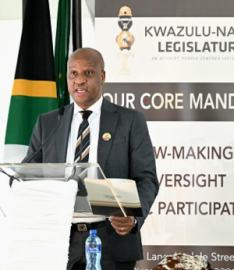
Delivering the State of the Province Address (SOPA), Premier Thamsanqa Ntuli said the province has emerged from “profound disruption” that tested the resilience of its economy, institutions and communities.
The unrest and pandemic resulted in a loss of life, destruction of infrastructure, business closures and a sharp erosion of investor confidence.
“Yet, out of this period of hardship, we made a deliberate choice as a government: not merely to rebuild what was lost, but to reimagine and reconstruct our provincial economy on a more inclusive, resilient, and sustainable foundation,” Ntuli said on Friday.
Guided by this resolve, the provincial government subsequently embarked on a coordinated recovery and reconstruction programme, focused on restoring stability, strengthening governance and rebuilding trust with social partners.
Strategic economic infrastructure was prioritised for protection, intergovernmental coordination was improved, and partnerships with the private sector, labour, and traditional leadership were reinforced.
“These interventions were essential in signalling that KwaZulu-Natal remains open for business and committed to policy certainty, institutional integrity, and long-term growth,” Ntuli said.
The efforts, he added, are beginning to yield positive results.
The Premier highlighted that KwaZulu-Natal’s economy under the Government of Provincial Unity, is showing encouraging signs of steady recovery, as it grew by 1.8% in 2025, a moderate but notable improvement from the subdued post-pandemic period and slightly above the national average growth expectation.
“The growth forecast for 2026 points to a further expansion to 2.1%. This projected increase reflects continued economic stabilisation, underpinned by improvements in energy supply and gradual recovery in key infrastructure systems, particularly in rail and port operations. These improvements are critical to restoring investor confidence and unlocking the full productive capacity of our province,” the Premier said.
Investment
Ntuli highlighted that in late 2025, the province surpassed R100 billion in investment pledges from domestic and international investors, a significant milestone following years of low growth and structural constraints.
The pledged projects are expected to generate more than 100 000 jobs and significantly strengthen economic activity across multiple sectors.
Tourism, one of the key economic pillars, recorded a strong performance in 2025, with the festive season alone having contributed an estimated R13 billion to the provincial Gross Domestic Product (GDP), driven by high domestic and international visitor numbers.
Between mid-2025 quarters, KwaZulu-Natal recorded a net gain of approximately 54 000 new jobs, a development that supported household income, boosted consumer spending, and reinforced broader economic growth.
Despite these gains, the provincial government acknowledges that structural constraints remain.
The Premier said historical electricity disruptions, freight inefficiencies and persistent rail and port bottlenecks, continue to limit higher growth potential, while slow national economic expansion exerts additional pressure on the provincial performance.
“Investor confidence is steadily recovering, reflected in renewed engagements with domestic and international investors, increased project pipelines, and growing interest in key sectors such as manufacturing, logistics, energy, agriculture, and tourism.”
R168 billion required to create additional jobs
Ntuli also highlighted the scale of the employment challenge facing the province. He said the province requires about 461 000 additional jobs to reduce unemployment from 30.8% to the targeted 20%. Achieving this would require approximately R168 billion in investment.
He said it is estimated that R168 billion is required to create the additional 461 000 jobs, emphasising the need for coordinated public-private investment and district-focused industrial development strategies.
Economists estimate that GDP growth of 5% or higher is required to significantly reduce unemployment, given the province’s relatively low employment elasticity, where a 1% increase in GDP translates into a 0.5% or lower rise in employment.
With growth projected to peak at 2.1%, the Premier said current expansion rates would likely absorb new labour market entrants but fall short of clearing the existing backlog of 461 000 people needed to drop the unemployment rate to 20%.
Growth path
To accelerate progress, Ntuli said the province is pursuing an infrastructure-led and industry-driven growth path under the KwaZulu-Natal Inclusive Growth Strategy.
Plans include scaling up informal sector development through enhanced cross-border trade and smart infrastructure interventions, such as public Wi-Fi and improved amenities to support township and rural economies.
The revival of the King Shaka International Public Link Solution is also on the agenda to improve connectivity between Durban, Pietermaritzburg, Richards Bay and Margate, strengthening economic corridors within the province.
In addition, KwaZulu-Natal has engaged the National Department of Trade, Industry and Competition (dtic) to secure an industrial stimulus package aimed at upgrading industrial parks and Special Economic Zones (SEZs).
“The Trade and Investment KwaZulu-Natal is mandated to facilitate Small Micro Medium Enterprises (SMMEs) participation in cross-border trade, leveraging opportunities under the African Continental Free Trade Area,” said the Premier. – SAnews.gov.za


