


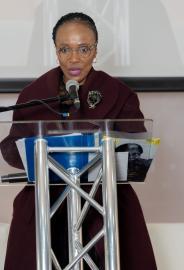
Minister in the Presidency for Women, Youth and Persons with Disabilities Sindisiwe Chikunga has described liberation struggle stalwart Gertrude Ntiti Shope as a towering figure whose contribution to South Africa’s freedom and women’s empowerment continues to shape the country.
Chikunga was delivering the keynote address at the Gertrude Ntiti Shope Memorial Lecture, held at Freedom Park in Pretoria on Saturday, where she honoured Shope’s lifelong contribution to the liberation struggle and reflected on the lessons her life holds for current and future generations.
Chikunga noted that the memorial lecture was particularly significant in 2026, as South Africa marks 70 years since the historic 1956 Women’s March to the Union Buildings, when 20 000 women united against apartheid pass laws.
She said Shope’s life was a powerful illustration of this year’s Women’s Month and Platinum Jubilee Year theme: “Empowered Women, Empower Nations.”
The Minister described Shope as a trained teacher who gave up her profession as part of the campaign to boycott Bantu Education, a wife and mother who raised her children in exile, and a political leader who returned to South Africa after nearly 25 years to rebuild the women’s movement.
“The League she rebuilt in the 1990s has produced Speakers of our Parliament, Premiers, Ministers and judges. She empowered an entire generation, and through that generation, a nation,” Chikunga said.
She said Shope’s contribution should be remembered not only as part of South Africa’s history, but as an example of the resilience, courage and leadership of women who challenged oppression, despite enormous odds.
Chikunga recalled Shope’s decision to leave teaching in opposition to the Bantu Education system, saying she understood that education could either become an instrument of liberation or reproduce oppression from one generation to the next.
“She chose to disrupt this vicious cycle. She put her career aside because her generation understood that the Bantu Education Act of 1953 was designed not to educate but to manufacture servants,” Chikunga said.
She said the struggle against Bantu Education was fundamentally a struggle against apartheid’s broader system of racial and economic domination.
Chikunga also highlighted Shope’s leadership in the Federation of South African Women (FEDSAW), particularly its campaign for full equality of opportunity for women, regardless of race, colour or creed, and the removal of the social, legal and economic disabilities imposed on women.
She said Shope’s subsequent years in exile, during which she worked in countries including Czechoslovakia, Botswana, Tanzania, Zambia and Nigeria, further demonstrated her commitment to the liberation struggle and international solidarity.
“In each of these roles, Ma Shope demonstrated the limitless potential of women to excel in every area of human endeavour, even when the odds were heavily stacked against progressive forces.
“She demonstrated that women are not auxiliary participants in history. She demonstrated the capability of women as organisers, educators, diplomats, political strategists, legislators and leaders,” the Minister said.
Chikunga also paid tribute to Shope’s contribution to rebuilding the women’s movement following her return to South Africa, saying her influence extended beyond her own generation.
She quoted former International Relations and Cooperation Minister Naledi Pandor, who in 2022 described Shope as belonging to “a rare breed of women” whose impact on the country’s political progress was yet to be fully appreciated.
According to Chikunga, remembering Shope is also important at a time when younger generations are sometimes encouraged to forget the past and focus exclusively on the future.
The Minister commended Freedom Park for hosting the memorial lecture and helping to preserve Shope’s legacy.
“A nation cannot move confidently into its future if it has been taught to forget the people whose sacrifices made that future possible,” Chikunga said.
She said Shope’s legacy remained relevant to contemporary debates, particularly around women’s empowerment, education, migration, human dignity and South Africa’s relationship with the rest of the continent. – SAnews.gov.za


