


South Africa will use the 81st Session of the United Nations General Assembly (UNGA) to advocate for a stronger, more inclusive multilateral system while continuing to push for reforms that ensure Africa is permanently represented on the United Nations Security Council.
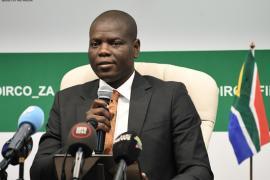
Speaking during a media briefing in Pretoria on Wednesday, Minister of International Relations and Cooperation (DIRCO), Ronald Lamola, said South Africa remains firmly committed to the principles of the United Nations Charter and international law, arguing that the current global crisis demands stronger rather than weaker multilateral cooperation.
“We believe that the answer to the current crisis of multilateralism is not less multilateralism, but better and more inclusive multilateralism,” he said.
Lamola said South Africa's participation at this year's General Assembly comes at a critical juncture as conflicts continue to rage across different parts of the world, placing increasing pressure on the international rules-based order.
According to the UN provisional schedule, the High-level Meetings of the 81st Session are set to get underway with the opening date of the session set for 8 September 2026, and the general debate is scheduled for 22-26 September,as well as 28 September 2026.
He stressed that the consistent application of international law, including international humanitarian law, remains essential to protecting civilians, preserving the sovereignty of states and maintaining international peace and security.
“South Africa remains firmly committed to the purposes and principles of the United Nations Charter and international law, including international humanitarian law. Their consistent application is essential to protecting civilians, preventing conflict, preserving the sovereignty of states, and maintaining international peace and security,” the Minister said.
Equal application of international law
Lamola warned against the selective application of international law, saying doing so undermines the credibility of the international system.
“International law cannot be applied selectively. The credibility of the international system depends on the equal application of its rules, regardless of the power or influence of the states involved.
“When respect for the UN Charter and international humanitarian law erodes, it threatens not only those directly affected by conflict, but the integrity of the entire international order.”
He said South Africa would continue working closely with the international community to uphold these principles during the General Assembly.
Bangladeshi Presidency
South Africa will work closely with Bangladesh, which assumes the Presidency of the 81st Session of the United Nations General Assembly.
The Minister welcomed this year's theme, “Restoring Trust, Managing Transformation: A United Nations that Delivers for All,” saying it reflects the need for a multilateral system that is more effective, responsive and capable of addressing global challenges.
“South Africa will continue advancing these principles in close cooperation with the international community, particularly with Bangladesh, which holds the Presidency of the General Assembly during the 81st session,” Lamola said.
He said the theme speaks directly to rebuilding confidence in multilateral institutions at a time when international cooperation is under increasing strain.
Germany's leadership
Lamola also commended Germany for its stewardship of the 80th Session of the General Assembly.
He noted that South Africa had demonstrated its support by seconding an official from the Department of International Relations and Cooperation to the Office of the President of the General Assembly to advance Africa's priorities.
“We also commend the Presidency of the Federal Republic of Germany during the 80th session of the General Assembly.
“South Africa demonstrated its commitment to that Presidency by seconding an official from the Department of International Relations and Cooperation to the Office of the President of the General Assembly, specifically to support the advancement of the African agenda,” he said.
Lamola further acknowledged Ms Thandekile Tshabalala for her contribution during her secondment.
High-Level Week
South Africa's participation in the High-Level Week of the General Assembly will begin on 22 September 2026, when world leaders gather at the UN Headquarters in New York to deliberate on pressing global issues.
The country's delegation is expected to use the platform to advance its foreign policy priorities, including strengthening multilateralism, promoting peaceful resolution of conflicts, advancing sustainable development and advocating for reforms of global governance institutions.
New UN Secretary-General process begins
This year's General Assembly also coincides with the process to elect a new United Nations Secretary-General as the term of António Guterres draws to a close.
Lamola paid tribute to Guterres for his leadership during a period marked by multiple global crises.
“This 81st session of the General Assembly will also mark a change in guard as Secretary-General Guterres term draws and end. The process for the election of a new Secretary-General has begun.
“We commend the outgoing Secretary General for his leadership and commitment to multilateralism that is addressing the lived experience of all global citizens,” the Minister said.
Renewed push for Security Council reform
South Africa will continue advocating for comprehensive reform of the United Nations, including ensuring that Africa finally secures permanent representation on the Security Council.
“We look forward to working closely with the next incumbent in a manner that reforms the UN so that it is fully reflective of a post-colonial society, with Africa finally being represented on the Security Council,” he said.
Lamola said reforming the United Nations remains critical to ensuring the institution reflects contemporary global realities and is better positioned to respond to the challenges facing developing countries.
He said South Africa would continue to champion a rules-based international order founded on equality among nations, respect for sovereignty and the peaceful resolution of disputes. - SAnews.gov.za


