


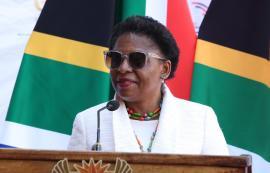
Minister in the Presidency Khumbudzo Ntshavheni has reaffirmed government’s commitment to advancing gender equality and honouring women’s legacies at the inaugural Portraits of Power exhibition, which pays tribute to Charlotte Mannya Maxeke’s enduring contribution to women’s leadership and social justice.
“In South Africa, we remain firmly committed to advancing gender equality and the empowerment of women. This commitment is rooted in our Constitution and reflected in our policies, programmes and partnerships. We recognise that inclusive leadership is not optional,” the Minister said on Tuesday, in Pretoria.
The Minister was addressing the launch of the Portraits of Power Exhibition, which celebrates extraordinary women whose courage, leadership and contributions have shaped nations and inspired generations.
The International Portraits of Power exhibition is a Charlotte Mannya-Maxeke Institute initiative presented in partnership with The Presidency of the Republic of South Africa and participating diplomatic missions.
“Portraits of Power goes beyond celebration. It is a recognition that women’s contributions transcend borders, cultures and generations. Across the globe, women are at the forefront of leadership, diplomacy, innovation and development.
“They are shaping policies, building communities and driving progress in ways that are both transformative and enduring.
“Therefore, the Presidency will continue to support this initiative and others like it, because the story of humanity is incomplete without recognising the invaluable contributions of women across all spheres of life,” Ntshavheni said.
The Portraits of Power project forms part of a series of legacy projects commemorating the 155th birthday anniversary of Mannya-Maxeke.
“Charlotte Mannya Maxeke was a woman of remarkable strength and enduring influence, and a trailblazer in every sense. As the first Black woman to graduate with a university degree in Southern Africa, we tend to limit her to being the first Black woman to graduate in South Africa, but she was the first Black woman to graduate with a degree in Southern Africa after obtaining her Bachelor of Science degree on 20 June 1901, from Wilberforce University in the United States of America. Mannya-Maxeke led the path for women’s rights and gender equality,” the Minister said.
Ntshavheni pointed out that Mannya Maxeke was the only woman present when the South African Native National Congress, later known as the African National Congress, was formed in 1912.
“Mannya Maxeke decisively asserted the need for women’s representation in the corridors of power in South Africa. She went on to become the founding president of two of the most important women-led institutions on the continent. Of particular importance to us is the Bantu Women’s League, which later evolved into the ANC Women’s League in the 1940s,” the Minister said.
While the government has made strides in empowering women since South Africa attained freedom, the Minister said the journey toward full equality is not yet complete.
“There remains work to be done to ensure that women everywhere in the world have equal access to opportunities, resources, platforms for leadership and education,” the Minister said.
She emphasised the importance of inclusive leadership, saying it is essential for sustainable development, social justice and lasting peace.
“We also recognise that achieving this vision requires collaboration. It requires governments, the private sector, civil society and the international community to work together to create environments where women can thrive, lead and succeed.
“Therefore, let this exhibition be more than a moment of admiration. Let it be a call to action. Let us commit to supporting and elevating the voices of women in all spaces.
“Let us invest in their potential and remove the barriers that hinder their progress. Let us strengthen global partnerships that promote equality, dignity and opportunity for all.
“In doing so, we not only honour the legacy of those who came before us, like Maxeke and the other women who are being honoured today, but we also ensure that, through this initiative and others like it, we are paving the way for the celebration of future generations of women leaders,” Ntshavheni said. -SAnews.gov.za


