


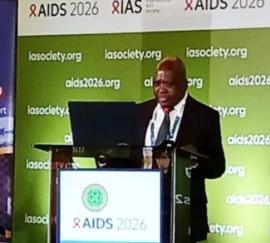
Deputy Minister of Health, Dr Joe Phaahla, has urged Southern African countries to urgently transition towards financial self-reliance to sustain their HIV responses as traditional international donor streams begin to recede.
Phaahla made the assertion at the Southern African Development Community (SADC) Secretariat session during the 26th International AIDS Conference held in Rio de Janeiro, Brazil.
The session was held under the theme: Sustaining the HIV Response in Southern Africa Beyond 2030 and took place against the backdrop of significant funding pressures threatening the global HIV response, including the withdrawal of funding from the US Agency for International Development (USAID).
“When we speak about sustainability today, we must recognise that the concept has evolved. Sustainability is no longer simply about replacing donor funding or filling resource gaps.
“Rather, sustainability is about ensuring that countries have the institutions, systems, financing mechanisms, workforce capacity, governance structures, and community partnerships required to maintain HIV gains for generations to come,” the deputy minister stated.
Phaahla characterised health sovereignty as a central pillar to the SADC’s strategy and emphasised that countries must “determine the direction of their own health responses”.
“It means mobilising domestic resources, strengthening public health systems, building national capacity, and shaping partnerships according to national priorities rather than external agendas.
“Health sovereignty does not mean working alone. Rather, it means engaging in partnerships from a position of leadership, ownership, and shared accountability,” the deputy minister explained.
He noted that South Africa’s own National Sustainability Framework provides “valuable insights in this regard”.
The framework was developed to support South Africa’s transition toward a more sustainable and country-led HIV response.
The framework notes that sustainability must be built across the following six interconnected domains:
- Epidemic control.
- Financial sustainability.
- Service delivery.
- Governance and accountability.
- Strengthening of critical social and community enablers.
- Resilient systems for health.
“Together, these domains acknowledge that sustainability cannot be achieved through isolated interventions.
“It requires integrated programmes, capable systems, and strong institutions that work together to maintain epidemic control through domestic leadership and financing, complemented by predictable external support,” Phaahla noted.
Solidarity the greatest strength
Phaahla stressed that even as health strategies are drawn up, no country can go at it alone, making regional collaboration “more important than ever before”.
With challenges become increasingly interconnected, regional solidarity is now the SADC’s greatest strategic assets.
“Through collaboration, countries can strengthen cross-border continuity of HIV services, ensuring that people remain connected to care regardless of where they live, work, or travel.
“Regional cooperation can also support joint procurement and supply-chain efficiencies, helping countries maximise limited resources and improve access to essential medicines and commodities.
“It enables shared learning, knowledge exchange, and innovation. It strengthens our ability to mobilise both domestic and international resources. And it allows us to coordinate responses to emerging public health threats that do not respect national borders,” he said.
The Deputy Minister asserted that the SADC’s goals should be to build HIV responses that:
- Domestically led and community-driven
- Financially sustainable
- Integrated within primary health care and Universal Health Coverage
- Resilient enough to withstand future shocks.
“The future of the HIV response in Africa will not be defined solely by the resources we receive, but by the systems we build, the partnerships we strengthen, and the leadership we demonstrate.
“Through sustainability, regional solidarity, and health sovereignty, SADC has an opportunity not only to end AIDS as a public health threat, but to create a lasting model of African-led health development for generations to come,” Phaahla concluded. – SAnews.gov.za


