


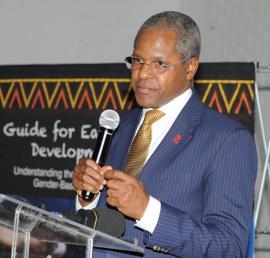
Cooperative Governance and Traditional Affairs (COGTA) Minister Velenkosini Hlabisa has warned municipalities to stop adopting unfunded budgets, saying the practice undermines financial sustainability and misleads communities.
Addressing a joint media briefing in Pretoria on Tuesday with Finance Minister Enoch Godongwana on the temporary withholding of municipal equitable share transfers, Hlabisa said municipalities should only budget for expenditure that can be financed through available revenue.
"Unfunded budgets must come to an end," Hlabisa said.
He said municipalities must take responsibility for ensuring sound financial management, particularly as the current term of local government draws to a close ahead of the Municipal Elections scheduled for November 2026.
He warned that municipalities should not leave newly elected councils with severe financial challenges before they receive their next equitable share allocation.
The Minister said unfunded budgets are among the root causes of municipal financial distress, often resulting in municipalities failing to meet their obligations to employees, creditors and key service providers.
"When money has been given to a municipality, the municipality must pay water boards, SARS [South African Revenue Service], Eskom and everybody that a municipality owes, so that they do not experience a similar situation.
"Government departments and provincial governments must also pay municipalities. The whole value chain must function so that we do not experience this again," Hlabisa said.
The Minister said government will work closely with the South African Local Government Association (SALGA), organised labour, and other stakeholders to identify municipalities facing financial difficulties and intervene before more severe measures become necessary.
He said the emphasis will be on improving compliance and providing support to municipalities before financial problems escalate.
Improvements in municipal financial reporting
Hlabisa welcomed improvements in municipal financial reporting, noting that only one municipality failed to submit its annual financial statements last year, after the sector consistently achieved a 98% submission rate.
He said government aims to achieve full compliance by the 31 August 2026 deadline.
"We do not want even one municipality to fail to submit annual financial statements. The point is compliance," he said.
Drawing a comparison with household finances, Hlabisa said municipalities should budget within their means.
"If you earn R10 000, you budget according to the salary you receive. Where things go wrong in some municipalities, is that they budget on money they do not have."
He added that while some municipalities prioritise paying salaries, they often neglect statutory obligations such as payments to SARS, Eskom and water boards, creating deeper financial problems.
Hlabisa also called on residents, businesses, and government institutions to pay municipal rates and service charges, saying municipalities cannot deliver services without sufficient revenue.
"You cannot expect municipalities to render services if we do not pay. Municipalities will only be functional if ratepayers, businesses, and government entities pay what is due to municipalities," Hlabisa said.
He acknowledged that municipal dysfunction stems from several interconnected challenges, but expressed confidence that stronger cooperation, improved compliance and shared accountability will help restore municipalities to financial stability and improve service delivery.
Municipal equitable share
The Municipal Equitable Share is an unconditional allocation made to municipalities in terms of the Constitution and the annual Division of Revenue Act.
It is intended to support municipalities in performing their constitutional functions and to assist them in providing basic services to communities, particularly poor and vulnerable households.
On 7 July 2026, National Treasury announced the temporary withholding of the July 2026 Municipal Equitable Share transfers to 69 municipalities across all nine provinces. The decision followed persistent and serious non-compliance with the Municipal Finance Management Act (MFMA) and related regulations, despite previous support, guidance and engagements provided to municipalities. – SAnews.gov.za


